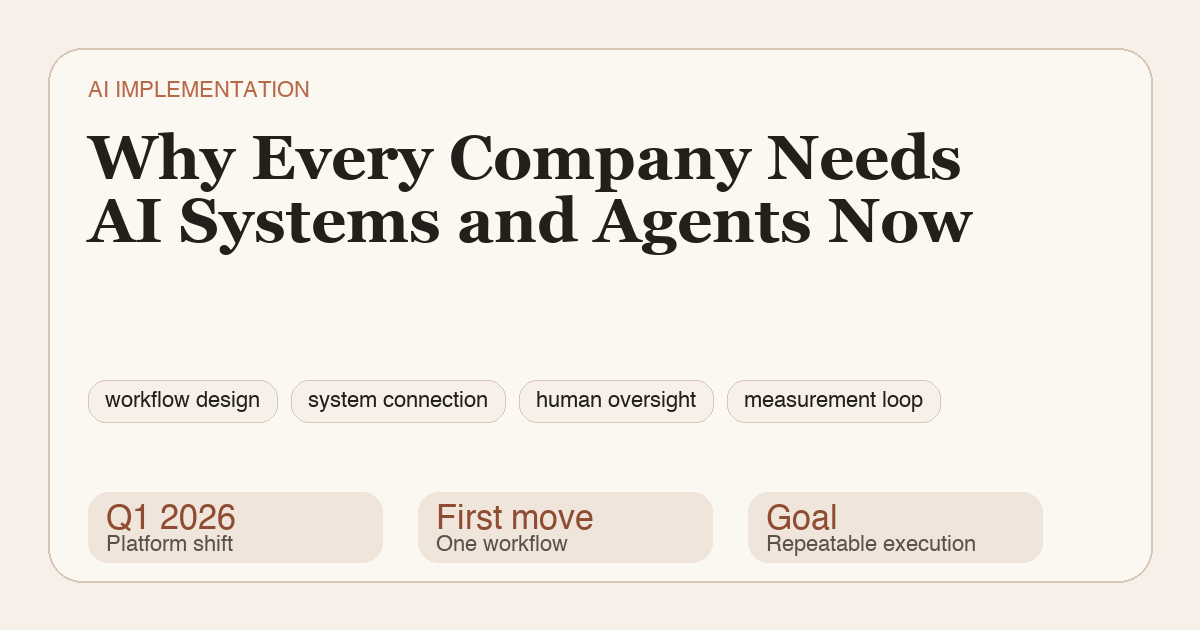
Short answer: companies need AI systems now because the advantage is no longer access to a chatbot. The advantage is building repeatable workflows, ownership, and data connections before competitors accumulate the operating knowledge you do not yet have.
Key Takeaways
- Q1 2026 made it clear that major platforms are shifting from isolated assistants to workflow-level agents and automation.
- The real risk of waiting is not just lost efficiency. It is learning slower than competitors who are already building AI habits into the business.
- Most companies do not need more AI tools; they need better systems, ownership, and measurement.
- The first wins usually show up in sales, marketing, and operations because those teams have the most repetitive work and direct revenue impact.
- The best first step is not a company-wide rollout. It is one clearly owned workflow with a measurable result.
The question is no longer whether AI will change how companies operate.
The question is whether a company will build systems around it fast enough to benefit before competitors do.
In just the first quarter of 2026, some of the largest technology platforms in the market moved from assistant language to agent language, company-wide deployment, and deeper workflow integration. That matters because once the platforms change, buyer behavior changes, team expectations change, and execution standards change with them.
Q1 2026 alone changed the timeline
This is not a vague future trend. It is already happening.
- On February 5, 2026, OpenAI launched Frontier, a platform explicitly framed around deploying AI coworkers across the enterprise.
- On February 23, 2026, OpenAI announced Frontier Alliances with BCG, McKinsey, Accenture, and Capgemini to help organizations roll out AI coworkers across departments.
- On February 17, 2026, Anthropic and Infosys announced work on AI agents for telecommunications, financial services, manufacturing, software development, and enterprise operations.
- On March 9, 2026, Microsoft said tens of millions of agents had appeared in the Agent 365 Registry in two months.
- On March 10, 2026, Google expanded Gemini in Workspace, adding deeper drafting, slide creation, and AI overview capabilities in Drive.
- Google also expanded AI Mode in Search to more than 200 countries and territories total.
That is a meaningful amount of change in less than three months. This is not one vendor making noise. It is a coordinated platform shift across search, productivity, enterprise software, and workflow tooling.
This changes more than tooling
AI is not just another feature in the stack. It is changing how buyers discover companies, how sales teams qualify and follow up, how marketing teams produce and personalize campaigns, how operations teams document and route work, and how leadership teams decide where to invest time and headcount.
Once AI moves into search, productivity suites, development workflows, and enterprise operations at the same time, the competitive effect compounds quickly. The companies that adapt early are not just getting more efficient. They are rewriting their internal standards for speed and output.
Companies that wait will not just move slower
They will learn slower. That is the bigger risk.
Companies that are building AI systems now are creating workflow knowledge, internal habits, cleaner data patterns, better prompts, stronger operating assumptions, and real implementation muscle.
Companies that wait are not just postponing efficiency gains. They are postponing the learning curve required to use AI well.
Most companies do not need more AI tools
They need better AI systems.
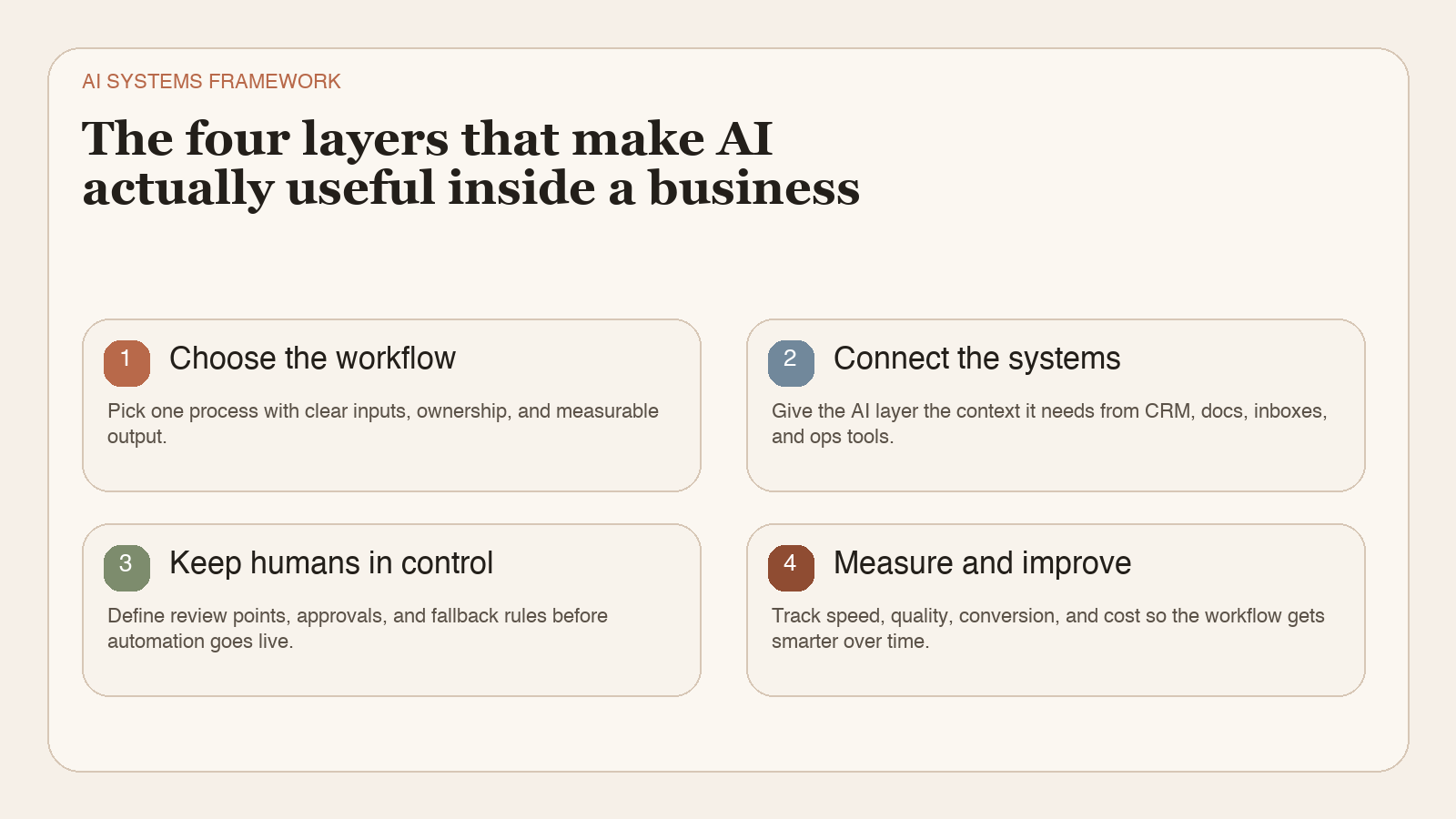
That usually means four things: clear workflow design, clear ownership, clear connection to the systems already running the business, and a feedback loop that measures whether the AI layer is actually improving output.
Without that, AI creates noise. With that, AI becomes part of how the business actually works.
Where AI systems matter first
For most companies, the first wins show up in sales, marketing, and operations because those functions contain the most repetitive work and usually have the clearest revenue or execution impact.
Sales
Sales teams usually benefit first from lead qualification, outbound research, follow-up support, pipeline hygiene, and meeting prep. These are structured workflows with visible inputs and visible outputs, which makes them easier to instrument and improve.
Marketing
Marketing teams get leverage from content production systems, audience and message analysis, campaign iteration, lifecycle workflows, and reporting. The key is not just producing more assets. It is creating a repeatable content and insight engine that helps the team test faster and personalize more intelligently.
Operations
Operations teams often see the highest internal leverage from knowledge retrieval, SOP enforcement, reporting automation, status updates, and handoff documentation. When those workflows improve, the whole company feels faster because fewer things get stuck in admin work.
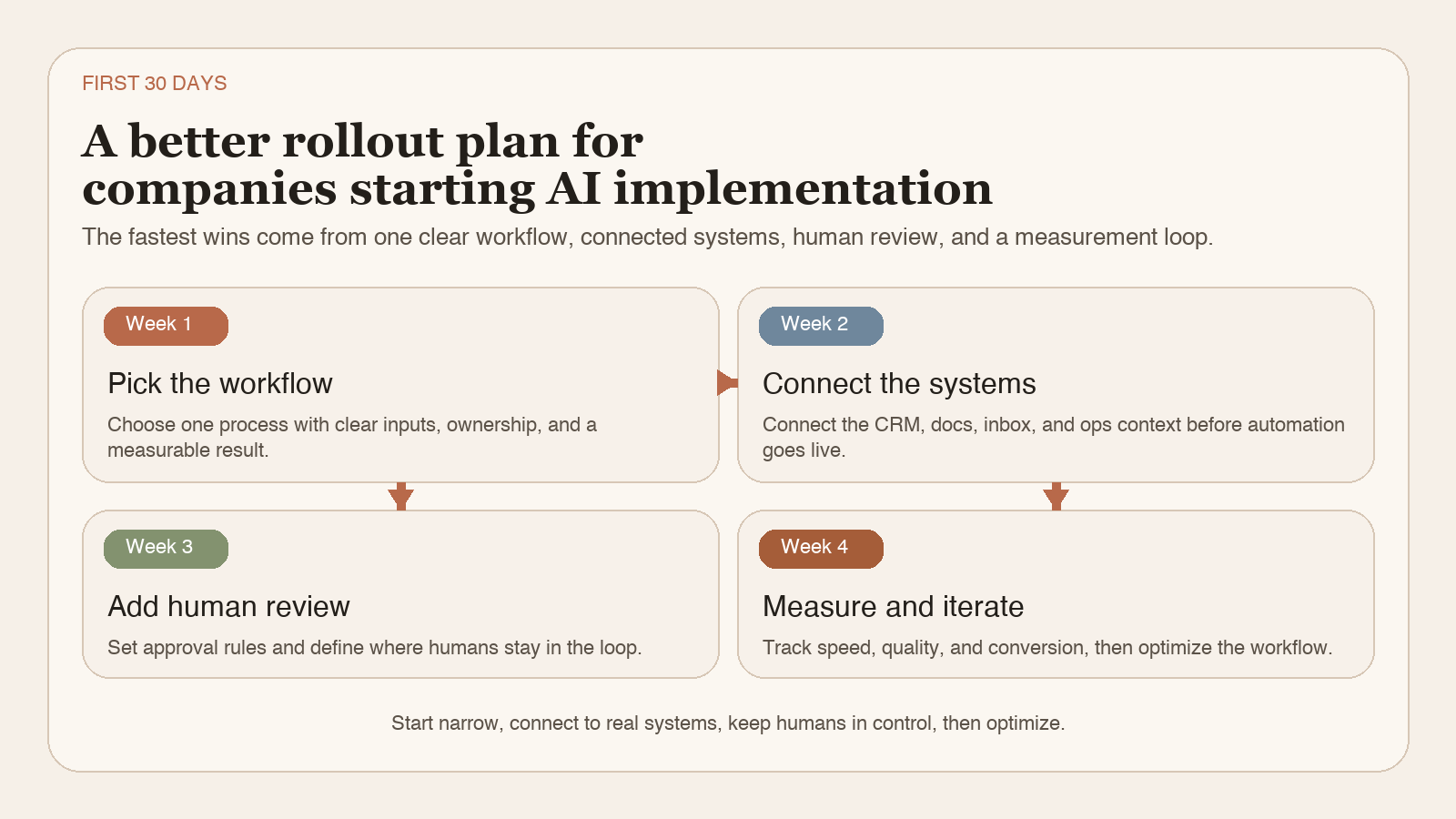
What to do in the first 30 days
If a company wants to move quickly without creating chaos, the first month should look more operational than inspirational.
- Choose one workflow with clear inputs, a clear owner, and a measurable outcome.
- Map the systems involved so the AI layer is not operating without business context.
- Define where human review is required and where automation can act without approval.
- Measure the baseline before rollout so you can compare quality, speed, cost, and conversion after launch.
- Iterate from one working workflow into the next, instead of launching ten disconnected experiments.
That is how companies turn AI from a pilot into an operating advantage.
What not to automate first
The worst starting point is a workflow nobody owns, nobody measures, and nobody trusts. If the process is already broken, AI often just makes the breakage happen faster.
I would not start with the most politically sensitive workflow, the highest-risk workflow, or the workflow that depends on undocumented tribal knowledge held by one employee. Start where the process is repetitive, the stakes are meaningful but manageable, and the team can see results quickly.
Well-funded startups are especially exposed
Startups with capital have more room to invest, but they also have less excuse to stay disorganized.
AI can help compress work that used to require more headcount, more manual coordination, and more lag between decision and action, but only if the company knows where AI should live, what it should own, how it should connect to the stack, and where humans still need to stay in the loop.
The real opportunity is not experimentation
It is implementation.
The companies that win from this wave will be the ones that identify the highest-leverage workflows, build agents and automations into those workflows, connect them to real systems and real ownership, measure performance, and keep improving from there.
That is the frame behind the work I do with clients: not one more disconnected chatbot, but an execution layer where agents, workflows, approvals, and people work together across the business.
Start now, because the platform shift is already underway
As of March 21, 2026, the signal is already clear. Search is moving. Productivity software is moving. Enterprise workflows are moving.
The companies that benefit most from the next two years of AI adoption will not be the ones with the loudest launch week. They will be the ones that quietly build implementation muscle before the rest of the market realizes how much leverage that creates.
Operator Decision Framework
The practical question is not whether AI can touch this work. The question is whether the work has enough structure for AI to improve it without creating more cleanup. I look for four signals before I trust a workflow with more automation: the input is reliable, the desired output is easy to recognize, the failure mode is manageable, and the next action is already defined.
If any of those signals are missing, the answer is not to avoid AI forever. The answer is to slow down and design the operating layer first. That usually means writing the checklist, naming the source of truth, choosing the review owner, and deciding what the system should do when the input is incomplete.
| Operating question | Good signal | Risk signal |
|---|---|---|
| Input quality | The source is current, specific, and easy to cite. | The AI has to guess which source is accurate. |
| Output standard | A reviewer can approve or reject the result quickly. | Everyone has a different opinion of what good means. |
| Failure mode | A mistake is caught before a customer or counterparty sees it. | A mistake creates legal, financial, or relationship damage. |
| Next action | The output moves into a known queue, CRM, calendar, or draft surface. | The output sits in a chat thread and gets forgotten. |
How I Would Implement This in a Real Business
I would start by choosing the smallest workflow that still matters. For a service business, that might be missed-call recovery, lead follow-up, estimate reminders, review requests, or weekly reporting. For a real estate operator, it might be deal intake, rent-roll review, seller follow-up, or lender package prep. For a founder-led consulting business, it might be proposal drafting, client onboarding, content repurposing, or inbox triage.
The first version should be deliberately narrow. The AI receives a defined input, produces one defined output, and writes the result somewhere visible. A human reviews the output for a few cycles, records what needed correction, and then turns those corrections into better instructions. That is how the system gets stronger without requiring constant babysitting.
Common Failure Modes to Watch
The most common failure is letting the AI create more surface area than the business can govern. More drafts, more alerts, more summaries, and more dashboards do not automatically mean better operations. The goal is fewer missed decisions and cleaner follow-through, not more things to look at.
The second failure is treating the AI output as proof. A summary is not proof. A draft is not proof. A completed checklist is not proof unless it points back to the source material that made the answer reliable. Strong AI systems make the proof easier to inspect.
Related Source Pages
This topic connects to the broader AI operating system I use across content, acquisition, and implementation work. These related pages are useful next steps:
- How to integrate AI into a small business
- AI integration roadmap
- AI automation mistakes
- AI vs hiring
- AI implementation consulting
Frequently Asked Questions
What is the main takeaway from Why Every Company Needs AI Systems and Agents Now?
The main takeaway is that AI only creates leverage when the workflow has clear inputs, clear standards, and a clear owner. The tool is not the operating system. The operating system is the set of rules that decides what the AI can do, what it must check, where the output goes, and when a person needs to make the final call.
How should a small business start applying this idea?
Start with one repeated workflow that already happens every week. Document the trigger, the source of truth, the expected output, the review rule, and the place where the final result is logged. Once that workflow is stable, use AI to reduce the repetitive work around it. Do not start by connecting every tool in the business at once.
What should stay with a human operator?
The human operator should own judgment, taste, relationship context, strategy, standards, and final accountability. AI can prepare drafts, summaries, research, intake notes, and follow-up queues, but the business still needs a person who understands the goal and can tell whether the output is good enough to use.
What makes this content useful for AI search and answer engines?
Answer engines need direct definitions, decision rules, examples, and complete context. A post is more likely to be useful when it answers the question early, explains the criteria, shows a practical framework, and includes related source pages that clarify how the concept works in a real business.
When is this approach not enough?
This approach is not enough when the business has no defined process, no source of truth, or no owner for review. In that case, the first project is operational design, not automation. The workflow needs to be clarified before AI can make it faster.
Final Takeaway
The baseline is simple: AI should remove manual work wherever the system has proof, feedback loops, and operating standards. Humans should own judgment, standards, relationships, and final accountability. When those roles are clear, the business gets leverage without turning every workflow into a new cleanup project.
Additional Operating Notes for Why Every Company Needs AI Systems and Agents Now
One reason this matters is that small businesses rarely fail at AI because they chose the wrong model. They fail because the workflow around the model is vague. The owner expects the system to know context that was never documented, the team expects a draft to be final, and no one knows where corrections should be stored. A better implementation makes those rules explicit.
That means the workflow should define the source, the output, the reviewer, the escalation path, and the evidence trail. If the system cannot show where the answer came from, the answer should be treated as a draft. If the system cannot explain what action happens next, the workflow is not finished. This is the difference between useful AI and more digital clutter.
Additional Operating Notes for Why Every Company Needs AI Systems and Agents Now
One reason this matters is that small businesses rarely fail at AI because they chose the wrong model. They fail because the workflow around the model is vague. The owner expects the system to know context that was never documented, the team expects a draft to be final, and no one knows where corrections should be stored. A better implementation makes those rules explicit.
That means the workflow should define the source, the output, the reviewer, the escalation path, and the evidence trail. If the system cannot show where the answer came from, the answer should be treated as a draft. If the system cannot explain what action happens next, the workflow is not finished. This is the difference between useful AI and more digital clutter.
Additional Operating Notes for Why Every Company Needs AI Systems and Agents Now
One reason this matters is that small businesses rarely fail at AI because they chose the wrong model. They fail because the workflow around the model is vague. The owner expects the system to know context that was never documented, the team expects a draft to be final, and no one knows where corrections should be stored. A better implementation makes those rules explicit.
That means the workflow should define the source, the output, the reviewer, the escalation path, and the evidence trail. If the system cannot show where the answer came from, the answer should be treated as a draft. If the system cannot explain what action happens next, the workflow is not finished. This is the difference between useful AI and more digital clutter.
Additional Operating Notes for Why Every Company Needs AI Systems and Agents Now
One reason this matters is that small businesses rarely fail at AI because they chose the wrong model. They fail because the workflow around the model is vague. The owner expects the system to know context that was never documented, the team expects a draft to be final, and no one knows where corrections should be stored. A better implementation makes those rules explicit.
That means the workflow should define the source, the output, the reviewer, the escalation path, and the evidence trail. If the system cannot show where the answer came from, the answer should be treated as a draft. If the system cannot explain what action happens next, the workflow is not finished. This is the difference between useful AI and more digital clutter.