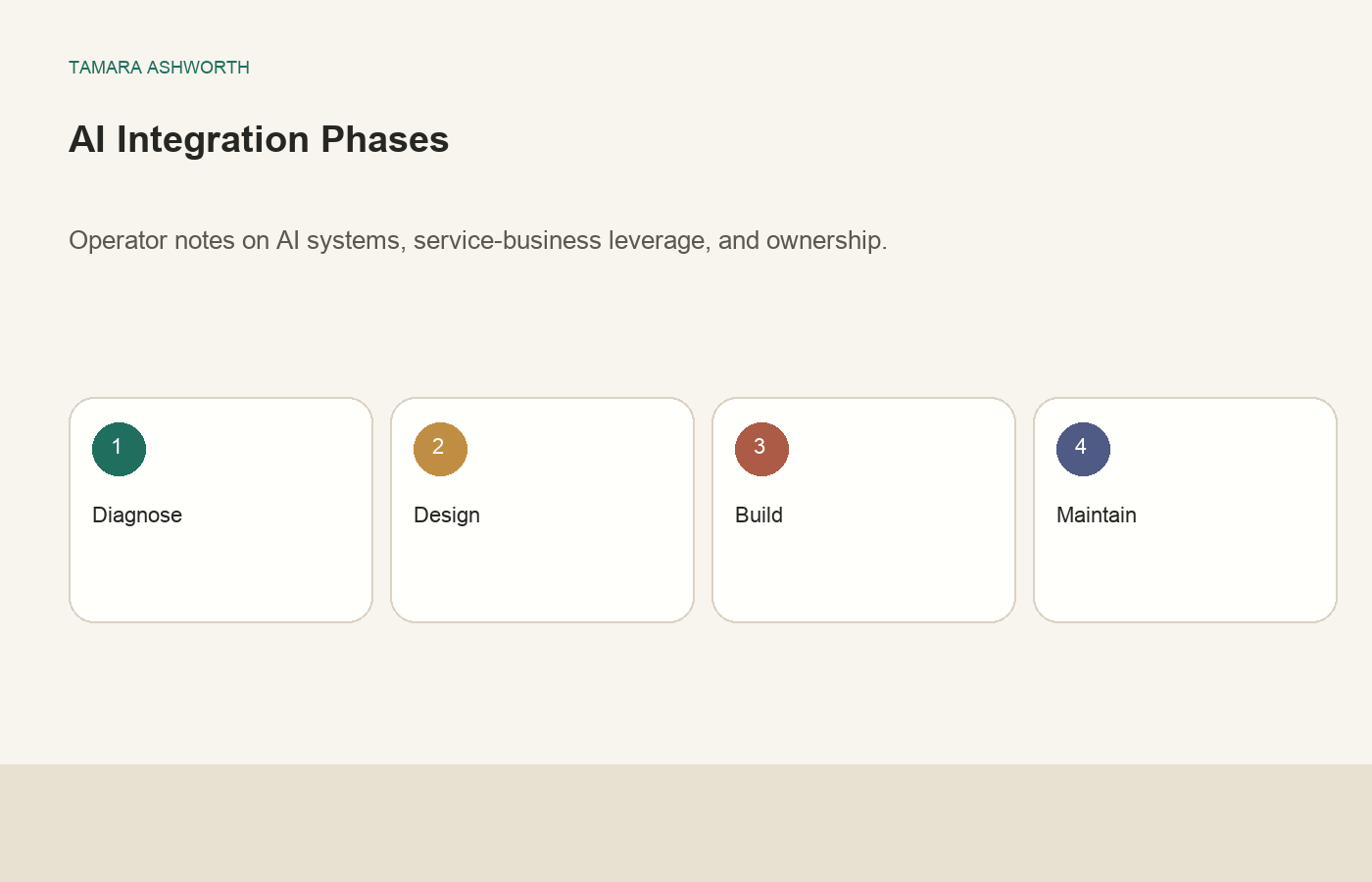
Short answer: an AI integration roadmap should move in this order: audit repetitive work, choose one low-risk pilot, build a human review gate, measure quality and time saved, then expand only after the first workflow is stable.
The Roadmap
| Stage | What happens | What to avoid |
|---|---|---|
| Audit | List recurring tasks and rank by frequency, cost, and risk. | Starting with a tool before choosing the workflow. |
| Pilot | Automate one repeatable workflow with clear inputs and outputs. | Automating five workflows at once. |
| Review | Keep a human approval step until quality is predictable. | Letting AI speak for the business before it is trained. |
| Measure | Track time saved, revision rate, and customer-facing risk. | Calling it successful because the demo looked good. |
| Expand | Add the next workflow only after the first one works. | Scaling a broken pilot. |
Best First Workflows
The best first AI projects are repetitive, reversible, and easy to review. Examples include first-draft content, meeting summaries, weekly reports, lead triage, CRM cleanup, and follow-up drafts.
What Should Stay Human
Final judgment, sensitive customer relationships, negotiation, legal or financial decisions, and brand-defining communication should stay human-led. AI should compress the work around those decisions, not replace the accountable person.
Where I Usually Start
I usually start by finding the owner bottleneck. If the owner is spending hours sorting information, drafting repetitive messages, or re-explaining the same process, that is usually a better first target than a fully autonomous customer-facing agent.
The owner bottleneck is also where the return is easiest to measure. If a founder spends five hours a week turning messy notes into follow-ups, the first version of the system does not need to be glamorous. It needs to take the notes, identify the next action, draft the response, flag missing information, and leave the owner with a clean approval decision. That is useful AI. It is narrow, measurable, and tied to work the business already has to do.
The Operating Layer Before the Tool Layer
Most AI roadmaps fail because they skip the operating layer. They choose the app, connect the account, and start prompting before anyone has answered the basic workflow questions: where does the input come from, what source is trusted, who reviews the output, what happens if the model is uncertain, and where does the final result get logged?
For a small business, those questions matter more than model choice. A better model can still produce a bad result if the source data is old, the prompt is vague, or no one knows who owns the final decision. A good roadmap starts with the business process, then chooses the AI layer that can support it.
Roadmap Rule
- Define the workflow before choosing the tool.
- Define the review owner before letting AI touch customers.
- Define the stop rules before calling anything autonomous.
- Define the measurement before expanding to the next workflow.
How to Score the First AI Pilot
I like a simple scoring model because it keeps the owner from choosing the flashiest project instead of the highest-leverage one. Score each possible workflow from 1 to 5 across four categories: frequency, time cost, risk, and review simplicity. The best first pilot is high frequency, high time cost, low to moderate risk, and easy to review.
| Workflow | Frequency | Time cost | Risk | Review simplicity | First-pilot fit |
|---|---|---|---|---|---|
| Weekly reporting | High | Medium | Low | High | Strong |
| Lead-intake summary | High | High | Medium | High | Strong |
| Customer refund decision | Medium | Medium | High | Medium | Not first |
| Legal contract review | Low | High | High | Low | Not first |
| Content outline draft | Medium | Medium | Low | High | Strong |
This is where AI starts to become operational instead of theoretical. The point is not to prove that AI can do everything. The point is to choose the first workflow where AI can remove real friction without creating a larger supervision problem.
What a Finished Roadmap Should Include
A finished AI integration roadmap should be concrete enough that someone else could run it. It should list the workflow, the owner, the source materials, the prompt or instruction file, the review criteria, the logging location, the escalation rules, and the metric that determines whether the workflow expands or stays in pilot.
For example, a lead follow-up workflow should not simply say "use AI to follow up with leads." It should say: new lead enters the CRM, AI summarizes the inquiry and drafts the first response, the owner reviews anything involving pricing or a custom promise, approved replies are logged back to the CRM, and the system reports weekly on response time, booked calls, and revision rate. That is the difference between a tool experiment and an operating system.
When to Expand Beyond the First Workflow
Do not expand because the pilot feels exciting. Expand when the review burden drops, the error pattern is known, and the metric improves for at least two cycles. If the AI saves three hours but creates two hours of cleanup, the workflow is not ready. If it saves three hours, reduces forgotten follow-ups, and the reviewer is mostly approving instead of rewriting, then the next workflow can be added.
The second workflow should usually sit next to the first one. If the first project is lead-intake summaries, the second might be follow-up drafts or CRM note cleanup. Keeping the roadmap clustered lets the context library improve faster and avoids a scattered tool stack that no one wants to maintain.
Practical 30-Day Sequence
| Week | Focus | Output |
|---|---|---|
| Week 1 | Workflow audit | A short list of repetitive tasks ranked by frequency, risk, and owner time. |
| Week 2 | Pilot build | One narrow workflow with clear inputs, expected outputs, and a human review gate. |
| Week 3 | Quality review | A simple scorecard for accuracy, revision rate, time saved, and failure modes. |
| Week 4 | Operating handoff | Written rules for who reviews, what gets logged, when the system stops, and what can expand next. |
What to Measure Before Expanding
A useful AI pilot should save time without creating a new quality-control burden. Measure how many outputs needed edits, how many were rejected, how much operator time was saved, and whether the system made the next action clearer. If the workflow still needs heavy rewriting or creates more questions than it answers, keep it in pilot mode.
Where AI Should Stop
The roadmap should include stop rules. AI should stop and ask for human review when the request involves money, legal exposure, customer conflict, confidential information, unclear facts, or a decision that changes the business relationship. Those stop rules are what make the automation usable in a real company.
For the broader framework, read how to integrate AI into a small business.
If you are planning the first pilot, read the common AI automation mistakes before you remove review gates. If the workflow touches customers, money, or reputation, use a human-in-the-loop AI system until quality is predictable.
Operator Decision Framework
The practical question is not whether AI can touch this work. The question is whether the work has enough structure for AI to improve it without creating more cleanup. I look for four signals before I trust a workflow with more automation: the input is reliable, the desired output is easy to recognize, the failure mode is manageable, and the next action is already defined.
If any of those signals are missing, the answer is not to avoid AI forever. The answer is to slow down and design the operating layer first. That usually means writing the checklist, naming the source of truth, choosing the review owner, and deciding what the system should do when the input is incomplete.
| Operating question | Good signal | Risk signal |
|---|---|---|
| Input quality | The source is current, specific, and easy to cite. | The AI has to guess which source is accurate. |
| Output standard | A reviewer can approve or reject the result quickly. | Everyone has a different opinion of what good means. |
| Failure mode | A mistake is caught before a customer or counterparty sees it. | A mistake creates legal, financial, or relationship damage. |
| Next action | The output moves into a known queue, CRM, calendar, or draft surface. | The output sits in a chat thread and gets forgotten. |
How I Would Implement This in a Real Business
I would start by choosing the smallest workflow that still matters. For a service business, that might be missed-call recovery, lead follow-up, estimate reminders, review requests, or weekly reporting. For a real estate operator, it might be deal intake, rent-roll review, seller follow-up, or lender package prep. For a founder-led consulting business, it might be proposal drafting, client onboarding, content repurposing, or inbox triage.
The first version should be deliberately narrow. The AI receives a defined input, produces one defined output, and writes the result somewhere visible. A human reviews the output for a few cycles, records what needed correction, and then turns those corrections into better instructions. That is how the system gets stronger without requiring constant babysitting.
Common Failure Modes to Watch
The most common failure is letting the AI create more surface area than the business can govern. More drafts, more alerts, more summaries, and more dashboards do not automatically mean better operations. The goal is fewer missed decisions and cleaner follow-through, not more things to look at.
The second failure is treating the AI output as proof. A summary is not proof. A draft is not proof. A completed checklist is not proof unless it points back to the source material that made the answer reliable. Strong AI systems make the proof easier to inspect.
Related Source Pages
This topic connects to the broader AI operating system I use across content, acquisition, and implementation work. These related pages are useful next steps:
- How to integrate AI into a small business
- AI integration roadmap
- AI automation mistakes
- AI vs hiring
- AI implementation consulting
Frequently Asked Questions
What is the main takeaway from AI Integration Roadmap for Small Businesses?
The main takeaway is that AI only creates leverage when the workflow has clear inputs, clear standards, and a clear owner. The tool is not the operating system. The operating system is the set of rules that decides what the AI can do, what it must check, where the output goes, and when a person needs to make the final call.
How should a small business start applying this idea?
Start with one repeated workflow that already happens every week. Document the trigger, the source of truth, the expected output, the review rule, and the place where the final result is logged. Once that workflow is stable, use AI to reduce the repetitive work around it. Do not start by connecting every tool in the business at once.
What should stay with a human operator?
The human operator should own judgment, taste, relationship context, strategy, standards, and final accountability. AI can prepare drafts, summaries, research, intake notes, and follow-up queues, but the business still needs a person who understands the goal and can tell whether the output is good enough to use.
What makes this content useful for AI search and answer engines?
Answer engines need direct definitions, decision rules, examples, and complete context. A post is more likely to be useful when it answers the question early, explains the criteria, shows a practical framework, and includes related source pages that clarify how the concept works in a real business.
When is this approach not enough?
This approach is not enough when the business has no defined process, no source of truth, or no owner for review. In that case, the first project is operational design, not automation. The workflow needs to be clarified before AI can make it faster.
Final Takeaway
The baseline is simple: AI should remove manual work wherever the system has proof, feedback loops, and operating standards. Humans should own judgment, standards, relationships, and final accountability. When those roles are clear, the business gets leverage without turning every workflow into a new cleanup project.
Additional Operating Notes for AI Integration Roadmap for Small Businesses
One reason this matters is that small businesses rarely fail at AI because they chose the wrong model. They fail because the workflow around the model is vague. The owner expects the system to know context that was never documented, the team expects a draft to be final, and no one knows where corrections should be stored. A better implementation makes those rules explicit.
That means the workflow should define the source, the output, the reviewer, the escalation path, and the evidence trail. If the system cannot show where the answer came from, the answer should be treated as a draft. If the system cannot explain what action happens next, the workflow is not finished. This is the difference between useful AI and more digital clutter.
Additional Operating Notes for AI Integration Roadmap for Small Businesses
One reason this matters is that small businesses rarely fail at AI because they chose the wrong model. They fail because the workflow around the model is vague. The owner expects the system to know context that was never documented, the team expects a draft to be final, and no one knows where corrections should be stored. A better implementation makes those rules explicit.
That means the workflow should define the source, the output, the reviewer, the escalation path, and the evidence trail. If the system cannot show where the answer came from, the answer should be treated as a draft. If the system cannot explain what action happens next, the workflow is not finished. This is the difference between useful AI and more digital clutter.
Additional Operating Notes for AI Integration Roadmap for Small Businesses
One reason this matters is that small businesses rarely fail at AI because they chose the wrong model. They fail because the workflow around the model is vague. The owner expects the system to know context that was never documented, the team expects a draft to be final, and no one knows where corrections should be stored. A better implementation makes those rules explicit.
That means the workflow should define the source, the output, the reviewer, the escalation path, and the evidence trail. If the system cannot show where the answer came from, the answer should be treated as a draft. If the system cannot explain what action happens next, the workflow is not finished. This is the difference between useful AI and more digital clutter.
Additional Operating Notes for AI Integration Roadmap for Small Businesses
One reason this matters is that small businesses rarely fail at AI because they chose the wrong model. They fail because the workflow around the model is vague. The owner expects the system to know context that was never documented, the team expects a draft to be final, and no one knows where corrections should be stored. A better implementation makes those rules explicit.
That means the workflow should define the source, the output, the reviewer, the escalation path, and the evidence trail. If the system cannot show where the answer came from, the answer should be treated as a draft. If the system cannot explain what action happens next, the workflow is not finished. This is the difference between useful AI and more digital clutter.
Additional Operating Notes for AI Integration Roadmap for Small Businesses
One reason this matters is that small businesses rarely fail at AI because they chose the wrong model. They fail because the workflow around the model is vague. The owner expects the system to know context that was never documented, the team expects a draft to be final, and no one knows where corrections should be stored. A better implementation makes those rules explicit.
That means the workflow should define the source, the output, the reviewer, the escalation path, and the evidence trail. If the system cannot show where the answer came from, the answer should be treated as a draft. If the system cannot explain what action happens next, the workflow is not finished. This is the difference between useful AI and more digital clutter.