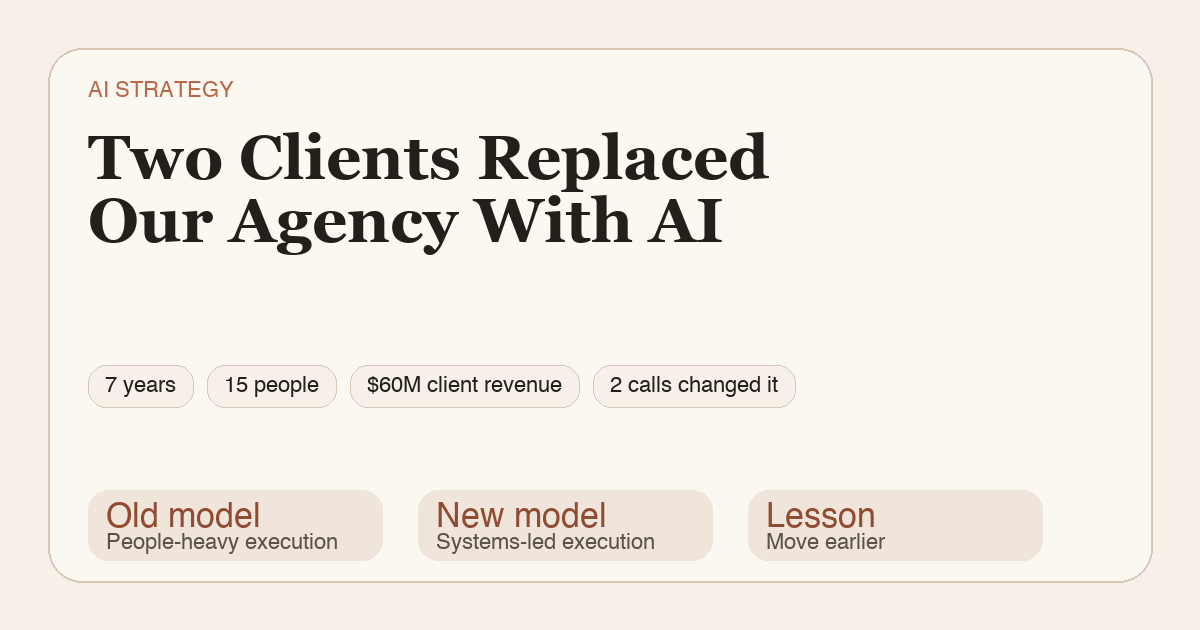
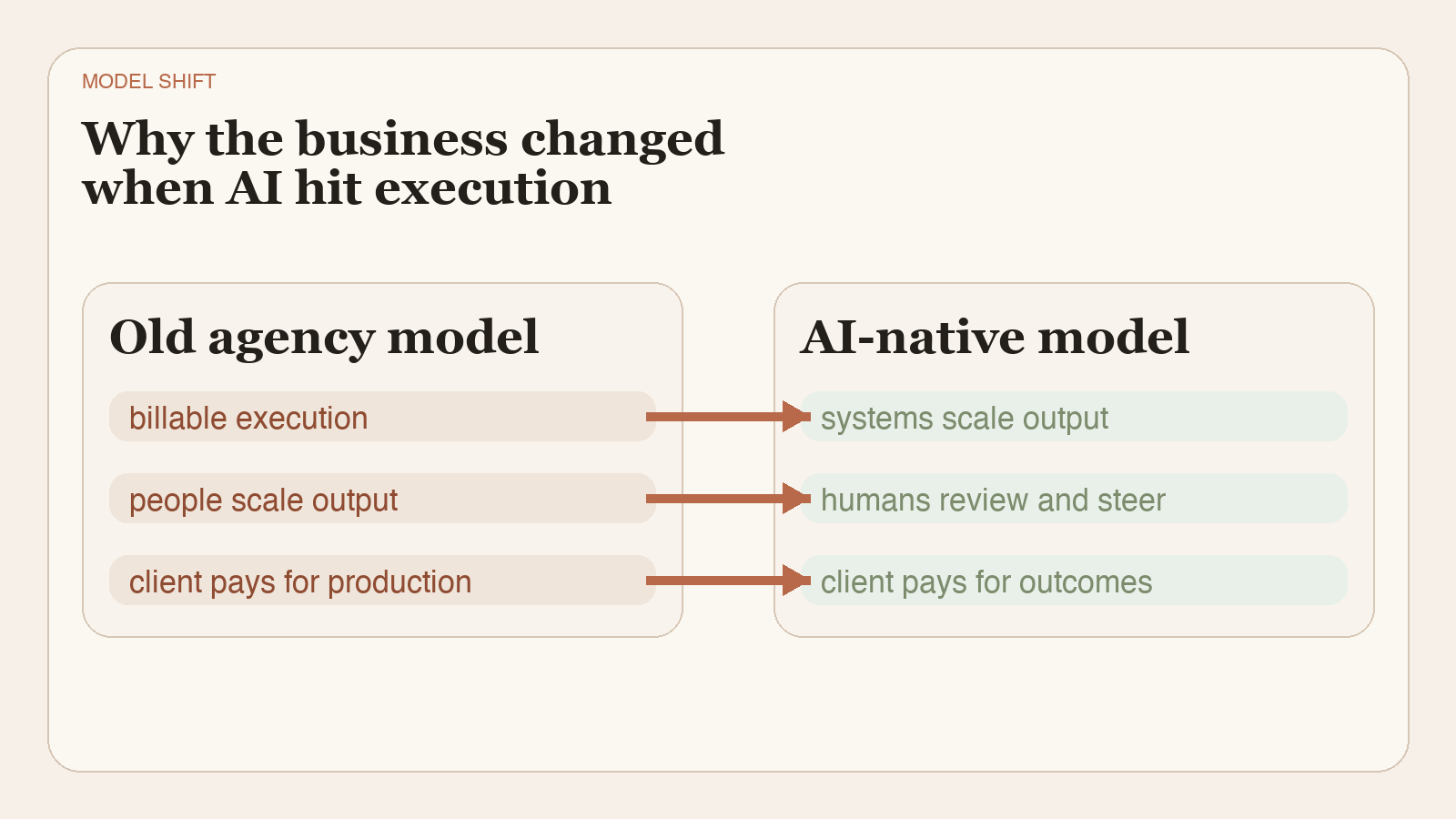
Short answer: I sold because AI was not just making agencies more efficient. It was compressing parts of the value stack agencies had historically billed for, and I could see that the learning curve for an AI-native operating model would matter more than preserving the old one.
Key Takeaways
- Two client calls were enough to show me that AI was changing agency economics, not just agency workflows.
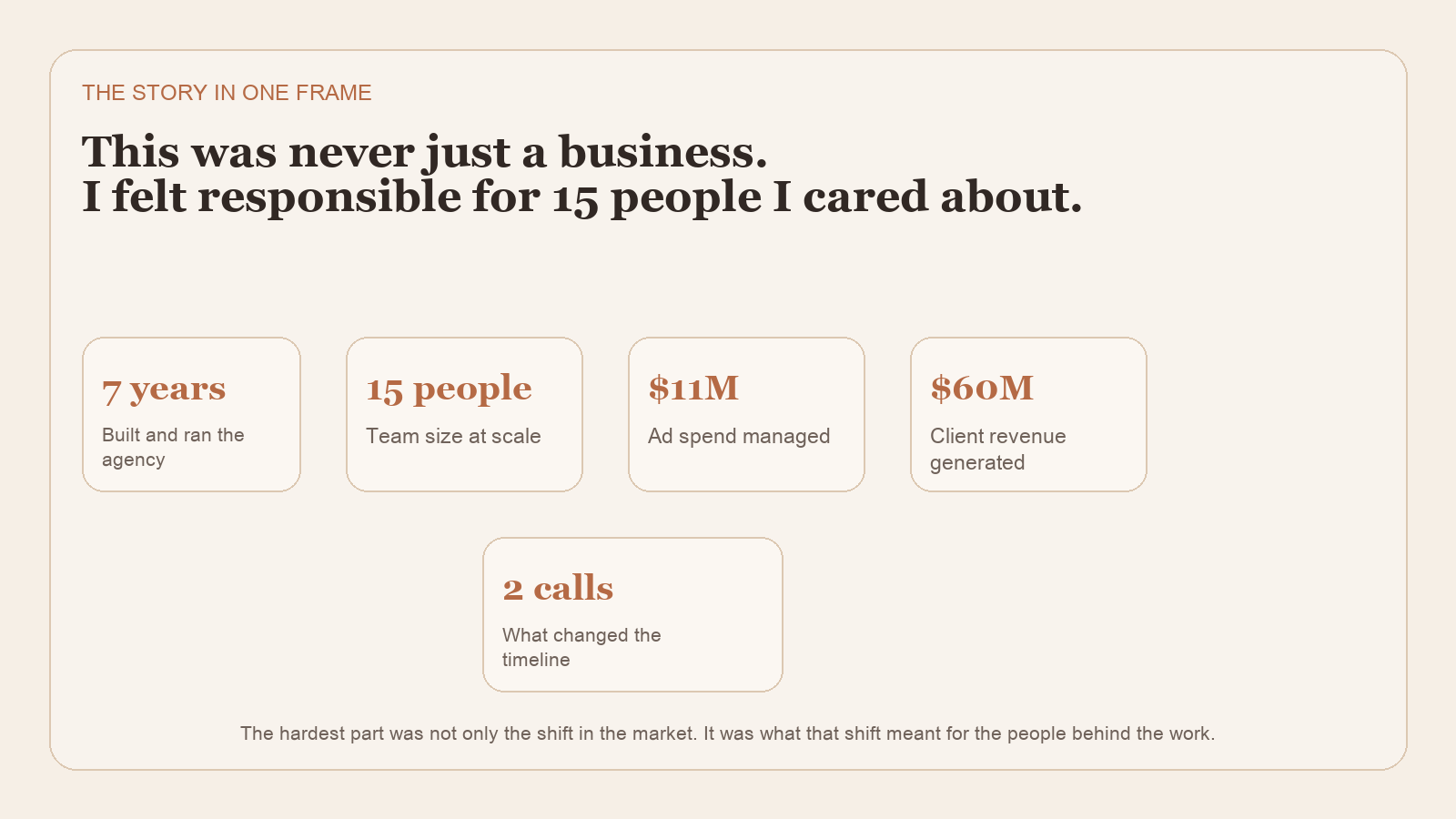
- The agency had real traction: seven years in business, a team of 15, $11 million in ad spend managed, and $60 million in client revenue generated.
- The biggest lesson was not "use more tools." It was to move earlier when a platform shift starts changing how clients buy.
- Paid acquisition without an organic engine makes an agency more fragile than it looks in good seasons.
- What replaced the old model for me was not a smaller agency. It was an AI-native systems business.
Two clients called me within the same month to say they were pausing their accounts with our agency.
Not because they were unhappy. Not because of budget cuts. Because they had tried AI-enabled ad and commerce tooling and were getting enough early traction to question whether they still needed the same agency model.
Those calls forced me to confront how quickly the agency model was changing and how much faster I needed to evolve Ashworth Strategy, the marketing agency I built over seven years, scaled to seven figures in annual revenue, and ran with a team of 15 people.
This is the full story of how I built it, what those calls changed for me, and the lessons I would hand to any founder who sees AI starting to touch the services they sell.
How I built a 7-figure marketing agency from scratch
I did not start out wanting to build an agency. I wanted to help companies with their go-to-market strategy.
My background was in pharmaceutical CPG. I had launched skincare products for a pharmaceutical company and understood the direct-to-market side of beauty. When I discovered Meta advertising, everything clicked.
For the first time, I could see growth happening in real time. You could test a creative, measure results in days, and launch in weeks. Compared to the slow grind of organic marketing, paid media felt like a superpower.
I combined my skincare industry knowledge with Meta advertising and built Ashworth Strategy around ecommerce beauty brands.
The early days were some of the most exciting of my career: hiring a team, building a company staffed largely by women, and working almost exclusively with female-founded brands. There was a real sense of alignment between the work we were doing and the founders we were helping grow.
We were supporting women inside our agency, growing female-led companies, who were then hiring women themselves, who were serving female consumers. That ripple effect became one of the most meaningful parts of the business.
The results we delivered
Over the life of the agency, we managed $11 million in total ad spend and generated $60 million in revenue for our clients, a 5.5x average return.
We worked with brands at every stage, from just launching to scaling past seven figures. Toupés & Co came to us as a startup almost nobody knew. We ran their Meta ads, built their audience, and helped them grow to the point where I now see their products on shelves at my local specialty health market in Charleston, South Carolina.
Beautiful Disaster Clothing hit multiple milestones while working with us, including their first six-figure revenue day and their first seven-figure revenue month. When you are in the room when a founder sees numbers like that for the first time, you understand why people build agencies.
What made ecommerce advertising so exciting and so stressful
Ecommerce is notoriously one of the hardest niches for a marketing agency. Everything moves fast. A creative that worked last week stops working this week. Inventory sells out at the wrong time. Trends shift overnight. Seasonality is brutal.
The pace was addictive. I loved how quickly you could see the impact of your decisions. In organic marketing, you plant seeds and wait months. In paid media for ecommerce, you plant seeds and watch them grow in real time.
But that same speed creates enormous pressure. When ads are your primary growth engine, for your clients and for your own business, you are subject to every fluctuation in the platform. Ad costs rise and fall unpredictably. Audience pockets dry up. Platform changes hit without warning. That volatility sat underneath every hard month we had.
The two phone calls that changed everything
When two separate clients told me they had paused our services to try newer AI-enabled tools and that they were actually getting results, I felt something shift.
These were not clients who were unhappy with our work. They had simply found a new set of tools that could do a meaningful portion of what we did faster and cheaper. That distinction mattered. This was not a sales problem. It was a model problem.
That is the part many agency founders still resist. The threat is not that AI instantly replaces every strategist, media buyer, creative, or operator. The threat is that it compresses enough of the execution layer that the old pricing model starts to feel expensive before the agency has rebuilt around higher-value work.
Meta itself now openly frames products like Meta Advantage+ as AI-led campaign automation, and Shopify positions Sidekick as an assistant that can operate inside the merchant's actual commerce stack. Those tools do not make strategy irrelevant, but they do reduce the amount of routine execution a founder has to buy from an outside team.
I immediately tried to pivot the agency. I wanted Ashworth Strategy to become an AI-first company using AI tools to augment the team's work, increase efficiency, and stay ahead of the curve.
It did not work.
Fifteen people who had been doing things a certain way for years do not change overnight. And honestly, that was not their fault. I had built the culture of comfort. I had created the processes, the habits, and the rhythm. Asking the team to reinvent themselves while simultaneously serving clients on deadline was like asking someone to rebuild a plane while flying it.
I realized that starting a new AI-native company from scratch would actually be easier than pivoting the existing one. That was the moment I decided to sell.
What I wish I had known about exiting a business
1. Start the exit process two to three years before you think you need to
This was the biggest surprise of the entire experience. Most successful agency exits involve a founder transition period of one to two years. That means the total timeline from "I think I want to sell" to "I am fully out" is often two to three years.
I did not start the process early enough. I kept delaying because I genuinely loved working with the team and did not want to let go. By the time I was ready, I wished I had been planning for years.
If you are building a business and think there is even a chance you might want to sell someday, start preparing now. Get your financials clean. Document your processes. Reduce your personal involvement in day-to-day operations. Build systems that run without you.
2. Build your organic engine even when paid ads are working
This is the lesson that still stings.
Because we were an advertising agency, we acquired our own clients through advertising. We never built a serious organic presence. No consistent content marketing. No SEO strategy. No brand-building on social media for our own agency.
That worked beautifully when ads were performing. But it created a dangerous dependency. When we hit slow pockets, and every agency does, we had no organic pipeline to fall back on. The companies that have the most stable growth and the most valuable exits are the ones that combine paid acquisition with organic sustainability.
3. When you see AI changing your industry, act immediately
The window between "this is interesting" and "this is existential" is shorter than most people expect.
I saw the signal with those two client phone calls. But instead of making a decisive move immediately, I spent months trying to gradually shift the team's approach. By the time I accepted that a full pivot was not possible with the existing team, I had lost valuable time.
If I could go back, I would have done one of two things much sooner: either aggressively implemented AI across every workflow in the agency, making it non-optional for the team, or started the exit process the moment the signal was clear.
What I would tell another agency founder right now
Do not ask whether AI can make your agency more efficient. That is too small a question.
Ask which parts of your current offer clients will still pay humans to do at the same margin two years from now. Ask which deliverables are becoming software features. Ask whether your pricing assumes a world where clients need outside help for work their tools are starting to do inside their own stack.
The deeper risk is not margin compression by itself. It is losing time on the learning curve while the market rewrites its expectations.
What I am doing now, and why it is different
Ashworth Strategy is still running, but those calls pushed me to go much deeper into AI, not from an academic perspective, but with the same operator mindset I brought to building the agency.
I built an AI system that handles SEO content, cold email outreach, voice reception, and lead generation, work that previously required multiple full-time employees. I experienced firsthand what it looks like when AI replaces not just one role, but an entire operational layer.
The important lesson was not simply that automation can reduce headcount. It was that the real leverage comes from designing workflows with clear ownership, approvals, fallbacks, and measurement. That is why I pay close attention to platforms like OpenAI Frontier, which are being built around business context, governed execution, and agents that can work inside real systems instead of floating outside the business.
Now I help founder-led businesses implement AI across sales, marketing, and operations. The perspective of having built and scaled a real company changes everything about how AI gets implemented. It starts with the business problem, not the technology.
If you are running a business where everything still depends on you, where you are the bottleneck in sales, operations, and decision-making, the AI tools available today can fundamentally change that. But only if they are implemented with an operator's understanding of how businesses actually work.
The short version
The story is not "AI killed my agency." The real story is that AI changed the economics of execution fast enough that I no longer wanted to build the next decade on the old model.
If your business sells time-intensive execution, the right question is not whether AI is coming for your category. The question is whether you are moving quickly enough to become the one who redesigns the category before someone else does.
Operator Decision Framework
The practical question is not whether AI can touch this work. The question is whether the work has enough structure for AI to improve it without creating more cleanup. I look for four signals before I trust a workflow with more automation: the input is reliable, the desired output is easy to recognize, the failure mode is manageable, and the next action is already defined.
If any of those signals are missing, the answer is not to avoid AI forever. The answer is to slow down and design the operating layer first. That usually means writing the checklist, naming the source of truth, choosing the review owner, and deciding what the system should do when the input is incomplete.
| Operating question | Good signal | Risk signal |
|---|---|---|
| Input quality | The source is current, specific, and easy to cite. | The AI has to guess which source is accurate. |
| Output standard | A reviewer can approve or reject the result quickly. | Everyone has a different opinion of what good means. |
| Failure mode | A mistake is caught before a customer or counterparty sees it. | A mistake creates legal, financial, or relationship damage. |
| Next action | The output moves into a known queue, CRM, calendar, or draft surface. | The output sits in a chat thread and gets forgotten. |
How I Would Implement This in a Real Business
I would start by choosing the smallest workflow that still matters. For a service business, that might be missed-call recovery, lead follow-up, estimate reminders, review requests, or weekly reporting. For a real estate operator, it might be deal intake, rent-roll review, seller follow-up, or lender package prep. For a founder-led consulting business, it might be proposal drafting, client onboarding, content repurposing, or inbox triage.
The first version should be deliberately narrow. The AI receives a defined input, produces one defined output, and writes the result somewhere visible. A human reviews the output for a few cycles, records what needed correction, and then turns those corrections into better instructions. That is how the system gets stronger without requiring constant babysitting.
Common Failure Modes to Watch
The most common failure is letting the AI create more surface area than the business can govern. More drafts, more alerts, more summaries, and more dashboards do not automatically mean better operations. The goal is fewer missed decisions and cleaner follow-through, not more things to look at.
The second failure is treating the AI output as proof. A summary is not proof. A draft is not proof. A completed checklist is not proof unless it points back to the source material that made the answer reliable. Strong AI systems make the proof easier to inspect.
Related Source Pages
This topic connects to the broader AI operating system I use across content, acquisition, and implementation work. These related pages are useful next steps:
- How to integrate AI into a small business
- AI integration roadmap
- AI automation mistakes
- AI vs hiring
- AI implementation consulting
Frequently Asked Questions
What is the main takeaway from Two Clients Replaced Our Agency With AI: Here's What I Learned?
The main takeaway is that AI only creates leverage when the workflow has clear inputs, clear standards, and a clear owner. The tool is not the operating system. The operating system is the set of rules that decides what the AI can do, what it must check, where the output goes, and when a person needs to make the final call.
How should a small business start applying this idea?
Start with one repeated workflow that already happens every week. Document the trigger, the source of truth, the expected output, the review rule, and the place where the final result is logged. Once that workflow is stable, use AI to reduce the repetitive work around it. Do not start by connecting every tool in the business at once.
What should stay with a human operator?
The human operator should own judgment, taste, relationship context, strategy, standards, and final accountability. AI can prepare drafts, summaries, research, intake notes, and follow-up queues, but the business still needs a person who understands the goal and can tell whether the output is good enough to use.
What makes this content useful for AI search and answer engines?
Answer engines need direct definitions, decision rules, examples, and complete context. A post is more likely to be useful when it answers the question early, explains the criteria, shows a practical framework, and includes related source pages that clarify how the concept works in a real business.
When is this approach not enough?
This approach is not enough when the business has no defined process, no source of truth, or no owner for review. In that case, the first project is operational design, not automation. The workflow needs to be clarified before AI can make it faster.
Final Takeaway
The baseline is simple: AI should remove manual work wherever the system has proof, feedback loops, and operating standards. Humans should own judgment, standards, relationships, and final accountability. When those roles are clear, the business gets leverage without turning every workflow into a new cleanup project.