Short answer: an AI SEO system can automate the daily chores of search marketing: keyword research, content refreshes, internal linking, and rank monitoring. It cannot replace owner judgment, and it cannot replace genuinely helpful content. I am building one for my own website anyway, in public, and this post is the blueprint. Not a promise of page-one rankings on autopilot. A working system, with the results published as they come in, good or bad.
Key Takeaways
- AI should own the daily SEO chores: data pulls, refresh candidates, link suggestions, and monitoring.
- The owner keeps strategy, proof, taste, and standards. That line is the whole system.
- Refreshing existing pages usually beats publishing more pages.
- A daily loop compounds. An occasional SEO project does not.
- Measure with a proof ledger, not vibes. Log every change and what happened after.
- No ranking guarantees. This is a public build-in-progress with real numbers to follow.
I ran a marketing agency for eight years before I sold it. We managed serious ad budgets on Meta, built funnels for ecommerce brands, and lived and died by measurement. One thing that period burned into me: the channels that compound are the ones you work every day, not the ones you visit every quarter. SEO is the clearest example I know. Almost every founder treats it as a project. Almost none treat it as a daily operating loop. That gap is what I am building into a system.
What an AI SEO system actually is (and is not)
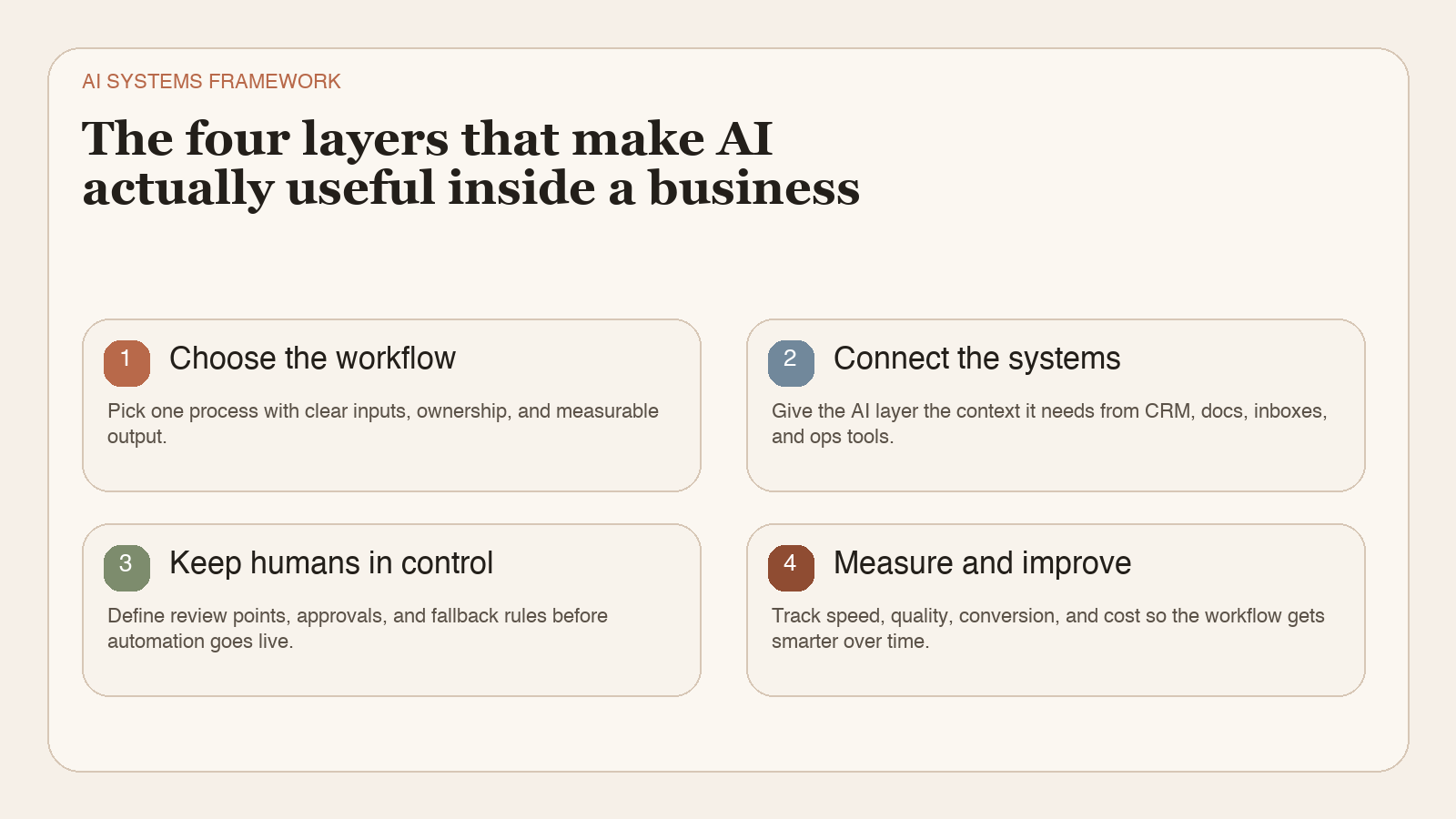
An AI SEO system is a set of scheduled workflows that do the repeatable parts of search marketing without a human pushing every button. Every day it pulls fresh data from Search Console, checks which queries are gaining impressions, flags pages sitting just off page one, drafts refresh suggestions for posts that have gone stale, proposes internal links between related pages, and writes everything it did into a log. That is it. No magic. It is the work a diligent junior SEO would do every morning, done by software that never skips a morning.
Here is what it is not. It is not a content farm. It is not a tool that publishes a hundred pages a week and hopes Google does not notice. Google has been explicit that using AI to generate content is fine when the content is helpful and made for people, and a problem when it is scaled low-value output made to manipulate rankings. Their guidance on AI-generated content is worth reading directly, because most of the fear and most of the hype both misquote it. The system I am building publishes less than most content calendars, not more. It spends most of its effort making existing pages better.
And it is not autopilot in the way a landing page selling you an "AI SEO tool" means autopilot. The name Page One Autopilot describes what the system is aiming at, not what it guarantees. Nobody can guarantee rankings. Not me, not an agency, not a tool. What I can automate is the daily discipline that gives good content its best shot.
Why I am building Page One Autopilot
Two reasons, and I will be honest about both.
The first is practical. I own multiple businesses and this website is one of my assets. Search traffic only becomes an asset when it compounds, and it only compounds when someone works the loop daily. I am not willing to become a full-time content manager for my own blog, and I am not willing to hire one for a personal site. That leaves systems. I already run AI systems across my portfolio for deal flow, follow-up, publishing, and operations. SEO is the next workflow on the list, and honestly it should have been earlier.
The second reason is proof. My consulting work is building AI operating systems for founder-led businesses. The strongest thing I can show a prospective client is not a slide deck. It is a system running on my own asset, with my own numbers, including the weeks where nothing moved. I wrote about how I decide which workflows to automate in the AI workflow ownership map, and SEO passes every screen: it is repetitive, it is data-driven, it has clear inputs and outputs, and the cost of a mistake is low as long as a human approves what ships. So this series is me eating my own cooking in public.
One more piece of context. I spent eight years buying attention with ad budgets. Paid traffic stops the day you stop paying. Search traffic keeps arriving after the work is done. If you have ever watched an ad account eat five figures a month, the appeal of an owned channel that compounds needs no further explanation.
What AI should do daily
Here is the chore list I am handing to the system. Every item on it is work that is boring, repeatable, and better done consistently than brilliantly.
Pull the data. Every morning the system pulls Search Console data: queries, impressions, clicks, and average position for every page. It compares today against the trailing 7 and 28 days. No human opens a dashboard.
Find striking-distance opportunities. Any query where the site ranks between position 4 and 20 with real impressions is a candidate. Those pages are the cheapest wins in SEO, because a small improvement moves them onto page one where the clicks actually live.
Flag refresh candidates. Pages losing impressions, pages with rising impressions but zero clicks, and pages whose content has quietly gone out of date. The system drafts the specific fix: a sharper direct answer at the top, an FAQ that matches what people actually type, updated numbers, a better title.
Propose internal links. When a new post goes live or an old one gets refreshed, the system scans the rest of the site for related pages and proposes links both directions. Internal linking is the most neglected lever in small-site SEO, mostly because it is tedious. Tedious is exactly what AI is for.
Watch the queue. The system checks that the publishing pipeline has drafts ready ahead of schedule and raises a flag when the runway gets thin, before a slot gets missed rather than after.
Log everything. Every change, every suggestion, every publish gets a line in a ledger with a date. This is the part almost everyone skips and it is the part that makes the whole thing a system instead of a pile of activity.
What the owner still decides
This is the section that matters most, because the line between AI chores and owner judgment is the difference between a system that builds an asset and a system that builds spam.
I decide strategy. Which topics this site should be known for, which clusters we build, and which keywords we ignore no matter how tempting the volume looks. A keyword tool cannot know that a query is off-thesis for my brand. I can.
I decide what claims go out under my name. Every number, every result, every statement about what I have done gets checked by me before it ships. AI drafts confidently whether it is right or wrong. The proof standard is mine to hold.
I decide taste. Voice, tone, what feels like me and what reads like a machine wearing my byline. I wrote this site's voice rules down precisely so my systems could follow them, but following rules and having taste are different things. The final read is mine.
I decide the quality bar. My publisher enforces a hard checklist before anything goes live: minimum depth, real structure, working links, no filler. When a draft fails, it gets blocked, and I would rather miss a slot than ship a page I am not proud of. A system with no standards is just a faster way to embarrass yourself.
| Daily AI chores | Owner judgment |
|---|---|
| Pull Search Console and keyword data every morning | Decide which topics the brand should be known for |
| Flag striking-distance pages and rising queries | Decide which opportunities fit the thesis and which to skip |
| Draft content refreshes, FAQs, and title improvements | Approve every claim, number, and story before it ships |
| Propose internal links between related pages | Set the voice, taste, and quality bar |
| Monitor the publishing queue and flag thin runway | Decide what never gets automated at all |
| Log every change and its result in the proof ledger | Read the ledger and decide what the numbers mean |
The daily loop from keyword signal to content refresh
Here is the loop end to end, using a real shape of a real day.
Signal. The morning pull shows a post sitting at position 9 for a query with growing impressions and almost no clicks. Position 9 means Google already believes the page is relevant. It just does not believe it enough.
Diagnosis. The system reads the page against the query and drafts a short ticket: the intro takes four paragraphs to answer the question, there is no FAQ matching the phrasing people actually search, and two newer posts on the site should link to it but do not.
Draft. The system writes the fix. A direct answer in the first two sentences. An FAQ block in the searcher's own words. Two internal link edits in the neighboring posts. A tightened title that says what the page delivers.
Review. The draft lands in my queue. I read it as the owner, not the writer. Is it true? Is it mine? Would I say it to a client's face? This takes minutes because the chore work is already done. If it fails, it goes back with a note.
Ship and log. Approved changes publish through the same pipeline as everything else on this site, and the ledger gets a line: date, page, change, and the position it started from.
Measure. Two weeks later the system checks the same query and writes down what happened. Moved to position 5? The pattern gets reused. Nothing moved? That is data too, and it goes in the post I will write about it.
signal -> diagnosis -> draft -> owner review -> ship -> log -> measure
   ^                                                              |
   |______________ what worked feeds the next cycle ______________|
How I will measure proof
I care about a small set of numbers, tracked weekly, published as this series continues.
Impressions by cluster. Total impressions for the queries each content cluster targets. This is the earliest signal that Google is connecting the site to a topic, and it moves before clicks do.
Striking-distance count. How many queries sit in positions 4 through 20. A healthy system keeps refilling this pool and keeps graduating pages out the top of it.
Clicks and conversions. Clicks from search, and how many of those visitors take a real action: a subscribe or a consulting conversation. Traffic that never converts is a vanity chart.
Refresh win rate. Of the pages the system refreshed, how many improved position within 30 days? This is the number I have almost never seen anyone track, and it is the one that tells you whether the loop itself works or whether you are just busy. My agency years made me allergic to activity metrics. Spend enough time reporting to clients on ad performance and you learn that the only honest scoreboard is the one that would still look bad if you wanted it to look good.
AI citations. Search is splitting between classic blue links and AI answers that cite sources. I track when engines like ChatGPT, Perplexity, and Google's AI Overviews cite this site, because that is where a growing share of discovery already happens. Same content quality bar feeds both. The broader industry writing on this shift, like Semrush's work on AI and SEO, matches what I see in my own data: structure and directness win citations.
What I will not automate
Some lines I am drawing now, in writing, so future-me cannot quietly erase them when a shortcut looks tempting.
I will not automate publishing net-new claims about results. If a post says a system produced a number, a human verified that number. No exceptions, because one invented statistic costs more trust than a hundred good posts earn.
I will not automate volume. The system will never mass-produce pages to chase every keyword variation. Ten pages that fully answer their questions beat a hundred thin ones, in rankings and in reputation. When two similar queries deserve one page, they get one page.
I will not automate the decision to delete or redirect content. Pruning matters, but it is a judgment call about what the site should be, and that is owner territory.
I will not automate my own reading of the numbers. The system prepares the report. Deciding what the report means, and what changes because of it, is the part of this that is actually my job. I laid out the same boundary in my guide to integrating AI into a business: automate the work, never the accountability.
Where this could fail, honestly
A build-in-public post that only lists upside is an ad. So here is my actual risk list.
The site could simply be too young in this topic cluster for daily discipline to overcome, and results could take longer than the series makes exciting. Google could change how it treats refreshed content and flatten the win rate I am counting on. The refresh loop could drift toward mediocrity, where every page becomes competently optimized and none of them say anything sharp, which is a taste failure the metrics will not catch on their own. And the honest one nobody puts in the sales page: I could get busy and let the owner-review step become a rubber stamp, at which point the whole system quietly degrades into the AI slop I built it to avoid. The mitigation for every one of these is the same ledger I described above. Written proof makes drift visible early. That is the entire reason it exists.
I watched AI eat my industry once already. It is a large part of why I sold my agency. The lesson I took was not that automation is dangerous. It was that the people who win are the ones who put AI on the chores and keep humans on the judgment, earlier and more deliberately than their competitors. This system is that lesson, applied to my own website.
How to start your own version this week
You do not need my full stack to start the loop. You need three things.
First, connect Search Console if you have not, and look at one report: queries where you rank between 4 and 20. That list is your opportunity pool, and most founders have never once looked at it.
Second, pick one page from that pool and run the loop manually with any capable AI assistant. Give it the page and the query. Ask for a direct-answer intro, an FAQ in the searcher's phrasing, and internal link suggestions. Review it like an owner. Ship what survives.
Third, start the ledger. A plain text file is fine. Date, page, change, starting position. Check it in two weeks. If the page moved, you just proved the loop on your own site, and everything I am building is that loop with the manual steps removed.
The rest of this series will cover the daily checklist, refreshing old content without creating spam, and how I track AI citations alongside rankings. Real numbers, as they happen.
AI SEO system: scheduled workflows that handle daily search chores such as data pulls, refresh drafts, internal link proposals, and rank monitoring, while a human owner keeps strategy, claims, taste, and final approval.
FAQ
What is an AI SEO system?
An AI SEO system is a set of automated workflows that handle the daily chores of search marketing: pulling keyword and impression data, flagging pages worth refreshing, drafting updates, checking internal links, and logging results. The owner still sets strategy, approves claims, and decides what ships.
Can AI really do SEO on autopilot?
AI can run the daily research, refresh, linking, and monitoring loop on autopilot. It cannot guarantee rankings, and it cannot replace judgment about what is true, useful, or on-brand. Anyone promising page-one results on full autopilot is selling something.
Will Google penalize AI-generated content?
Google's guidance targets low-value content produced at scale to manipulate rankings, not automation itself. Helpful, accurate, human-owned content is fine however it was drafted. The risk is publishing thin pages nobody checked, not using AI.
How long does an AI SEO system take to show results?
For an established site, refresh and internal-link improvements can move striking-distance pages in four to twelve weeks. For a younger site, expect six months or more before compounding is obvious. I am publishing my own numbers as I go so you can see a real timeline.
What SEO tasks should stay human?
Strategy, positioning, claims about results, pricing and offers, anything with legal or reputation risk, and the final quality bar. AI prepares the work. The owner decides what represents the business.
What do you need to build an AI SEO system?
Search Console access, a keyword tool for demand and difficulty data, an AI assistant that can read your content and data, a place to queue and review drafts, and a simple log that records what changed and what happened after. The tooling matters less than the daily loop.
Work With Me
If you want an AI system like this built for your business, with the chores automated and the judgment kept where it belongs, request a strategic AI consulting conversation. I build these systems for my own portfolio first, so what you get is what I actually run.
Author
Tamara Ashworth, 7-figure agency exit, 15-person team, and $60M in client revenue generated. Learn more about Tamara.
This content is for informational purposes only and reflects my operating perspective. It is not legal, tax, financial, or investment advice.