I am not an attorney, CPA, or financial advisor. Everything in this post reflects my personal experience and is shared for informational purposes only. Real estate transactions and tax strategies are complex and highly specific to your individual situation. Please consult a qualified tax professional or attorney before making any investment or tax-related decisions.
When most people look at a short-term rental listing, they evaluate the property. I evaluate the business.
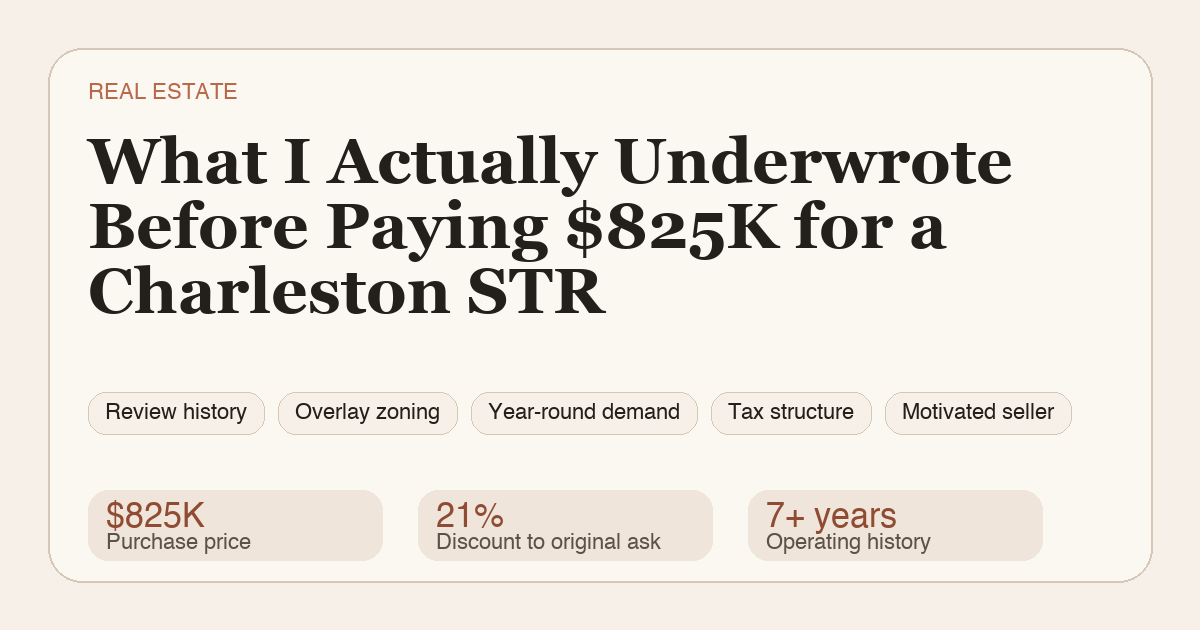
This downtown Charleston STR is a renovated 1852 Charleston Single House in Cannonborough-Elliotborough, one of the most walkable, historically protected neighborhoods in the city. On paper, it looks like a beautiful apartment. What made it worth $825,000 to me had almost nothing to do with the aesthetics, and everything to do with five specific things I underwrote before making an offer.
If you are looking at STRs as an investment vehicle, this is the framework I used.
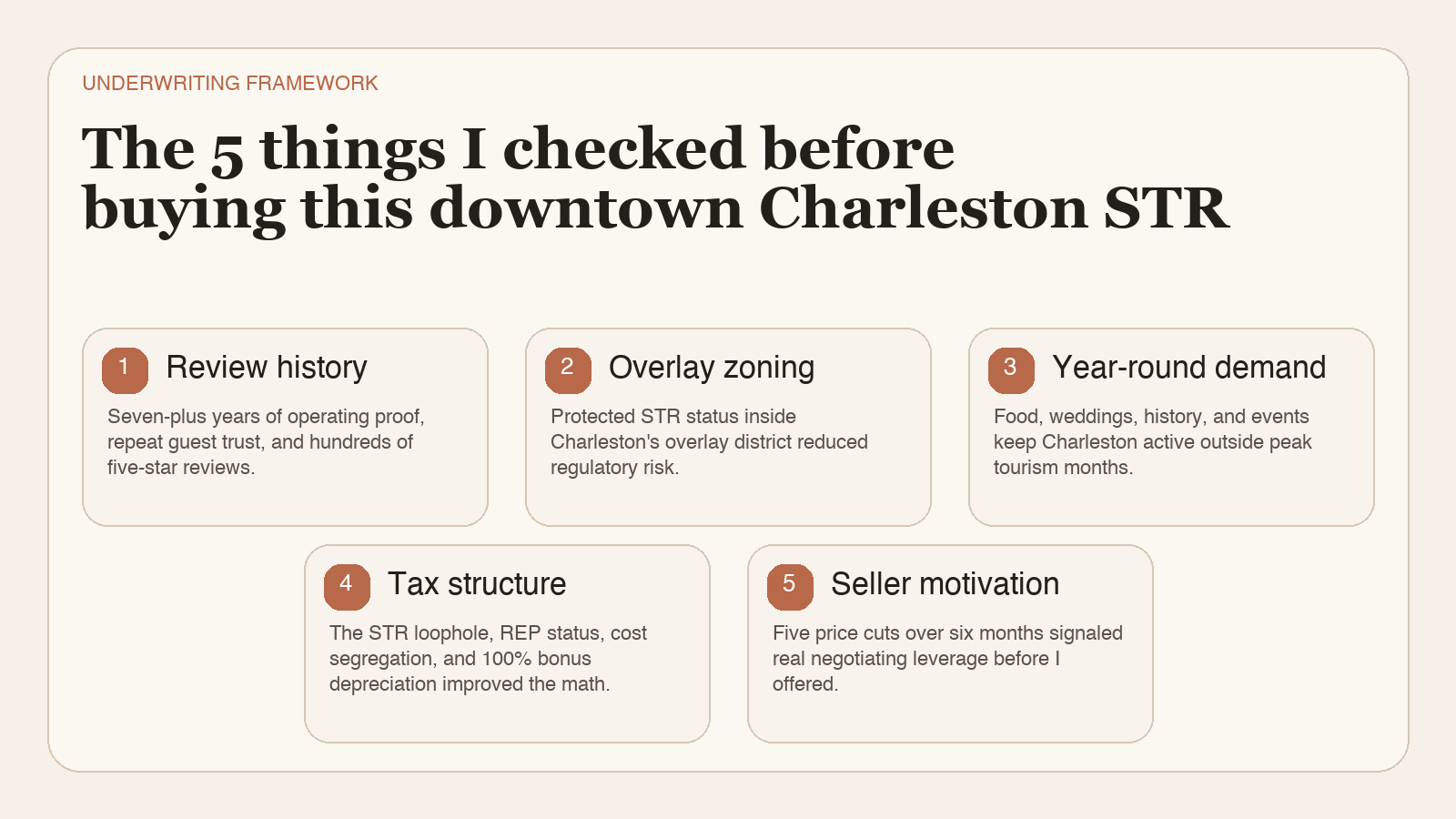
Short answer: I moved on this deal because it combined defensible business value, legal durability, stable year-round demand, unusually strong tax treatment, and a motivated seller with visible pricing pressure. If any one of those pieces had been missing, I would have passed.
Key Takeaways From This Deal
- The real asset was seven-plus years of review history and operating proof, not just the unit itself.
- Overlay zoning mattered because I wanted a legally protected downtown Charleston STR, not a regulatory gamble.
- Charleston's year-round travel demand made the underwriting more durable than a highly seasonal market.
- The STR loophole, REP status, cost segregation, and 100% bonus depreciation made the tax profile materially stronger.
- Five price reductions and a final close at $825,000 created the margin of safety.
For the legal and tax diligence behind this post, I also reviewed the City of Charleston's short-term rental categories and overlay guidance, the IRS rules in Publication 925, and the IRS depreciation guidance in Publication 946. I linked the primary source documents in the source list at the bottom of this post.
1. The Review History Was the Asset, Not the Unit
The listing had over seven years of operating history under the prior host. Hundreds of five-star reviews, a proven occupancy track record, and an established guest base. In the short-term rental world, that kind of social proof takes years to build and is genuinely hard to replicate from scratch.
Most buyers see a property. I saw a business with a reputation already attached to it.
That history also told me something the numbers alone could not: guests liked it, came back, and told their friends. That is the closest thing to a moat a short-term rental can have. When you are competing with newer listings in a strong market, years of reviews are worth real money.
One thing to know before you close on a property like this: the Airbnb listing lives under the prior host's account, not the property itself. Transferring it requires a formal case with Airbnb support, and that process is not guaranteed or fast. If you are buying a property with an existing STR listing, get clarity on this before closing. The review history is a real asset and protecting it should be part of your deal terms.
2. The STR Overlay Protects the Investment
If you have been paying attention to what is happening in STR markets across the country, you know that city-by-city regulation is one of the biggest risks to short-term rental income. Charleston has tightened its rules significantly over the past several years.
What made this deal structurally sound is that the property sits within Charleston's short-term overlay district. Properties in the overlay are zoned and licensed for short-term rental use. That does not mean the rules will never change, but it does mean I am not holding an asset that could be rendered non-compliant overnight.
If you are buying a short-term rental in a major city, this is not optional research. You need to know whether the property is in a protected zone, whether new permits are being issued, and what the trajectory of local regulation looks like. I will not buy an STR that is not in a protected zone, full stop. Charleston's own short-term rental permit information was part of my diligence stack here.
3. Charleston Is a Year-Round Market
A lot of STR investors chase beach or ski markets that perform for three or four months and go quiet the rest of the year. Charleston does not work that way. The city draws travelers for food, history, weddings, corporate events, and college visits consistently across all four seasons.
Before closing, I researched occupancy data and comparable operator performance in the market. Strong operators in Charleston maintain high occupancy year-round. That consistency matters when you are underwriting cash flow and stress-testing against slower months. Seasonal risk is a real underwriting variable. If your model only works in peak season, it is a fragile model.
4. It Qualified for the STR Loophole, REP Status, and 100% Bonus Depreciation
This is the piece most buyers miss entirely, and it is where the real financial engineering happens.
Here is how it works, and why the combination matters.
The STR loophole.
If your average guest stay is 7 days or fewer, the IRS does not classify your property as a traditional rental activity. That distinction matters enormously. It means the losses generated by the property, including large depreciation deductions, are treated as non-passive. Non-passive losses can offset your active income, including W-2 wages. Not just rental income. Not just passive income. Your actual earned income.
For a married couple, both spouses count as one taxpayer for material participation purposes. That means the losses can offset both spouses' W-2 income, which in our case includes my husband's income as well as mine.
REP status.
Real Estate Professional status is a separate but complementary designation. To qualify, you need to spend more than 750 hours per year in real estate activities and more time in real estate than any other profession. REP status reinforces the non-passive treatment and provides additional protection if your tax strategy is ever reviewed.
I already live in Charleston. I can get to the property easily, I log my hours, and the management time is real, not manufactured. That proximity made both the STR loophole and REP status achievable without overcomplicating the structure.
100% bonus depreciation, restored as of January 19, 2025.
Under the One Big Beautiful Bill Act, signed into law on July 4, 2025, 100% bonus depreciation was permanently restored for qualifying property acquired and placed in service after January 19, 2025. This had been phasing down since 2023 and was heading toward zero. It is now fully back.
What that means in practice: a cost segregation study identifies the components of your property that qualify as shorter-lived assets, typically 5-year, 7-year, and 15-year property. With 100% bonus depreciation, you can deduct the full value of those reclassified components in year one. On a property like this, that can produce a six-figure paper loss in the first year alone.
When you combine the STR loophole with cost segregation and 100% bonus depreciation, that first-year loss is non-passive and can be applied directly against both spouses' active income. That is the tax strategy working at full capacity.
On carryovers.
Losses you could not use in prior years as passive carryovers do not automatically become non-passive once you qualify for the STR loophole or REP status. Prior passive losses stay on Form 8582 until you have passive income to offset them or sell the property. What changes going forward is how new losses are classified each year. For any acquisition made after January 19, 2025, you are working with 100% bonus depreciation from day one.
This structure was a core part of why I moved quickly on this acquisition. The tax math is real, and the window to maximize it does not stay open forever.
As always, consult your CPA before making decisions based on any of this. The details of your specific situation, entity structure, income levels, and hours documentation all matter.
5. The Seller Was Motivated
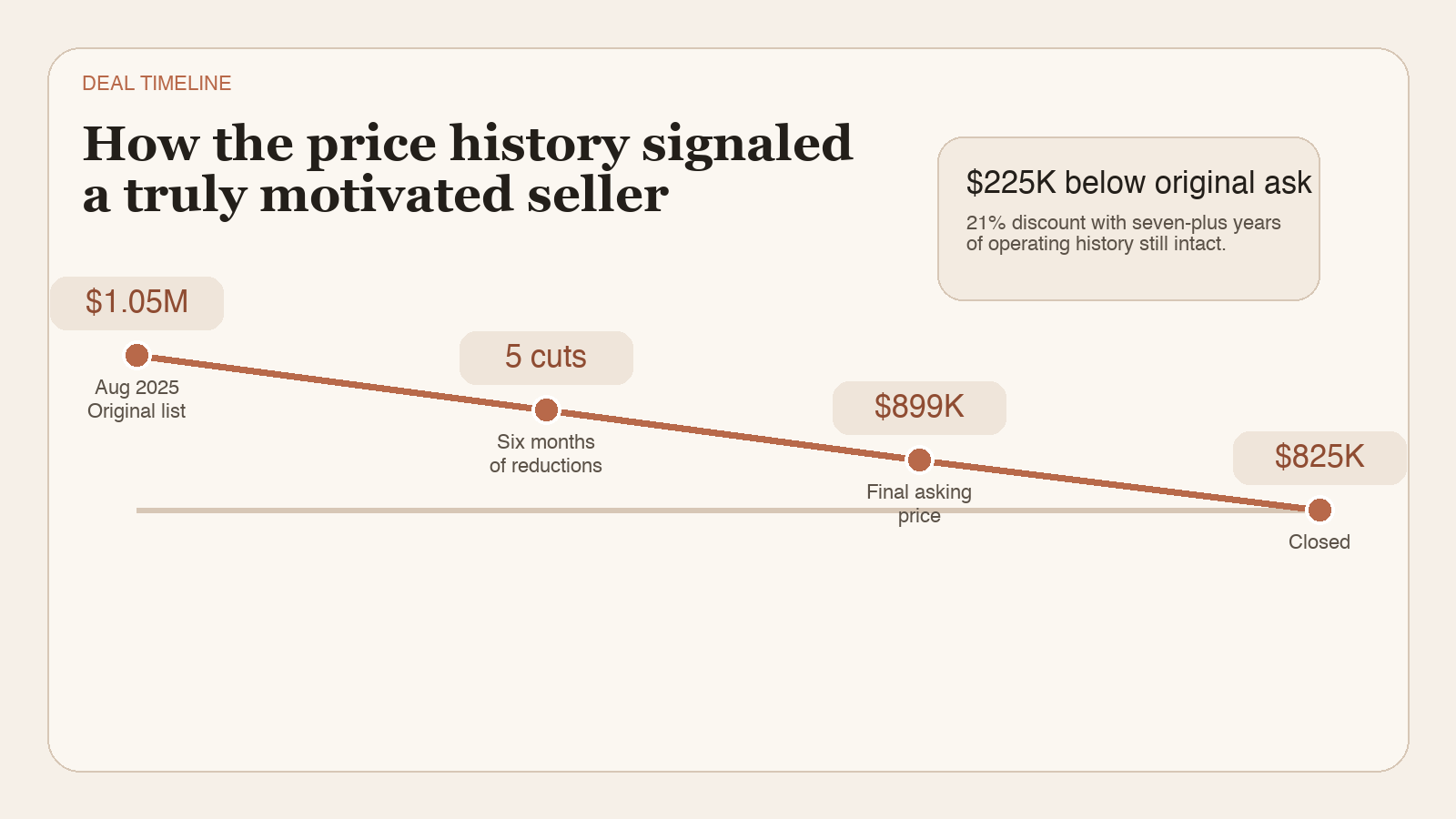
The property originally listed at $1,050,000 in August 2025. By the time I made my offer, it had been reduced five times over six months down to $899,000. I closed at $825,000. That is $225,000 below original asking price, a 21% discount on a property with seven years of operating history in a protected STR zone in downtown Charleston.
That kind of discount does not happen in a normal transaction. It happens when a seller needs out. This was a divorce and asset liquidation situation. Motivated sellers negotiate differently than someone who is testing the market, and the price history told me everything I needed to know before I even made an offer.
Motivation changes everything in a negotiation. When you find a seller who needs to move, you have leverage that has nothing to do with the property itself. I look for this on every deal. Five price reductions over six months is one of the clearest signals you will ever see.
What Would Have Made Me Walk Away
Just as important as what passed my underwriting is what would have killed the deal.
- No protected overlay status, or unclear permitting history.
- A weak review base with no operating proof and no realistic path to preserve the listing momentum.
- A highly seasonal market where the model only works in spring and fall.
- Tax assumptions that depend on aggressive interpretations instead of documented participation and CPA-reviewed planning.
- A seller who was emotionally anchored to the original list price with no room to negotiate.
What I Would Tell Someone Underwriting Their First STR
Stop starting with the property and start with the market. Is it year-round or seasonal? Is it regulated? Is there a protected zone, and is the property in it? What does the regulatory trajectory look like over the next five years?
Then look at operating history. Then look at the numbers. In that order.
The Fig House checked every box. That is why I closed.
Primary Sources I Used for This Diligence
- City of Charleston: Short term rental categories and overlay guidance
- City of Charleston: Short term rental permit information
- IRS Publication 925: Passive activity and real estate professional rules
- IRS Publication 946: Depreciation and special depreciation allowance
Operator Decision Framework
The practical question is not whether AI can touch this work. The question is whether the work has enough structure for AI to improve it without creating more cleanup. I look for four signals before I trust a workflow with more automation: the input is reliable, the desired output is easy to recognize, the failure mode is manageable, and the next action is already defined.
If any of those signals are missing, the answer is not to avoid AI forever. The answer is to slow down and design the operating layer first. That usually means writing the checklist, naming the source of truth, choosing the review owner, and deciding what the system should do when the input is incomplete.
| Operating question | Good signal | Risk signal |
|---|---|---|
| Input quality | The source is current, specific, and easy to cite. | The AI has to guess which source is accurate. |
| Output standard | A reviewer can approve or reject the result quickly. | Everyone has a different opinion of what good means. |
| Failure mode | A mistake is caught before a customer or counterparty sees it. | A mistake creates legal, financial, or relationship damage. |
| Next action | The output moves into a known queue, CRM, calendar, or draft surface. | The output sits in a chat thread and gets forgotten. |
How I Would Implement This in a Real Business
I would start by choosing the smallest workflow that still matters. For a service business, that might be missed-call recovery, lead follow-up, estimate reminders, review requests, or weekly reporting. For a real estate operator, it might be deal intake, rent-roll review, seller follow-up, or lender package prep. For a founder-led consulting business, it might be proposal drafting, client onboarding, content repurposing, or inbox triage.
The first version should be deliberately narrow. The AI receives a defined input, produces one defined output, and writes the result somewhere visible. A human reviews the output for a few cycles, records what needed correction, and then turns those corrections into better instructions. That is how the system gets stronger without requiring constant babysitting.
Common Failure Modes to Watch
The most common failure is letting the AI create more surface area than the business can govern. More drafts, more alerts, more summaries, and more dashboards do not automatically mean better operations. The goal is fewer missed decisions and cleaner follow-through, not more things to look at.
The second failure is treating the AI output as proof. A summary is not proof. A draft is not proof. A completed checklist is not proof unless it points back to the source material that made the answer reliable. Strong AI systems make the proof easier to inspect.
Related Source Pages
This topic connects to the broader AI operating system I use across content, acquisition, and implementation work. These related pages are useful next steps:
- How to integrate AI into a small business
- AI integration roadmap
- AI automation mistakes
- AI vs hiring
- AI implementation consulting
Frequently Asked Questions
What is the main takeaway from What I Actually Underwrote Before Paying $825,000 for a Charleston STR?
The main takeaway is that AI only creates leverage when the workflow has clear inputs, clear standards, and a clear owner. The tool is not the operating system. The operating system is the set of rules that decides what the AI can do, what it must check, where the output goes, and when a person needs to make the final call.
How should a small business start applying this idea?
Start with one repeated workflow that already happens every week. Document the trigger, the source of truth, the expected output, the review rule, and the place where the final result is logged. Once that workflow is stable, use AI to reduce the repetitive work around it. Do not start by connecting every tool in the business at once.
What should stay with a human operator?
The human operator should own judgment, taste, relationship context, strategy, standards, and final accountability. AI can prepare drafts, summaries, research, intake notes, and follow-up queues, but the business still needs a person who understands the goal and can tell whether the output is good enough to use.
What makes this content useful for AI search and answer engines?
Answer engines need direct definitions, decision rules, examples, and complete context. A post is more likely to be useful when it answers the question early, explains the criteria, shows a practical framework, and includes related source pages that clarify how the concept works in a real business.
When is this approach not enough?
This approach is not enough when the business has no defined process, no source of truth, or no owner for review. In that case, the first project is operational design, not automation. The workflow needs to be clarified before AI can make it faster.
Final Takeaway
The baseline is simple: AI should remove manual work wherever the system has proof, feedback loops, and operating standards. Humans should own judgment, standards, relationships, and final accountability. When those roles are clear, the business gets leverage without turning every workflow into a new cleanup project.