All notesAI Strategy

AI Business Integration: A Practical Operator's Guide

AI Business Integration: A Practical Operator's Guide explains a practical operator framework for applying AI with clear standards, useful proof, and business-specific workflow design.

June 17, 2026 · 13 minute read · By Tamara Ashworth
AI Business Integration: A Practical Operator's Guide feature image

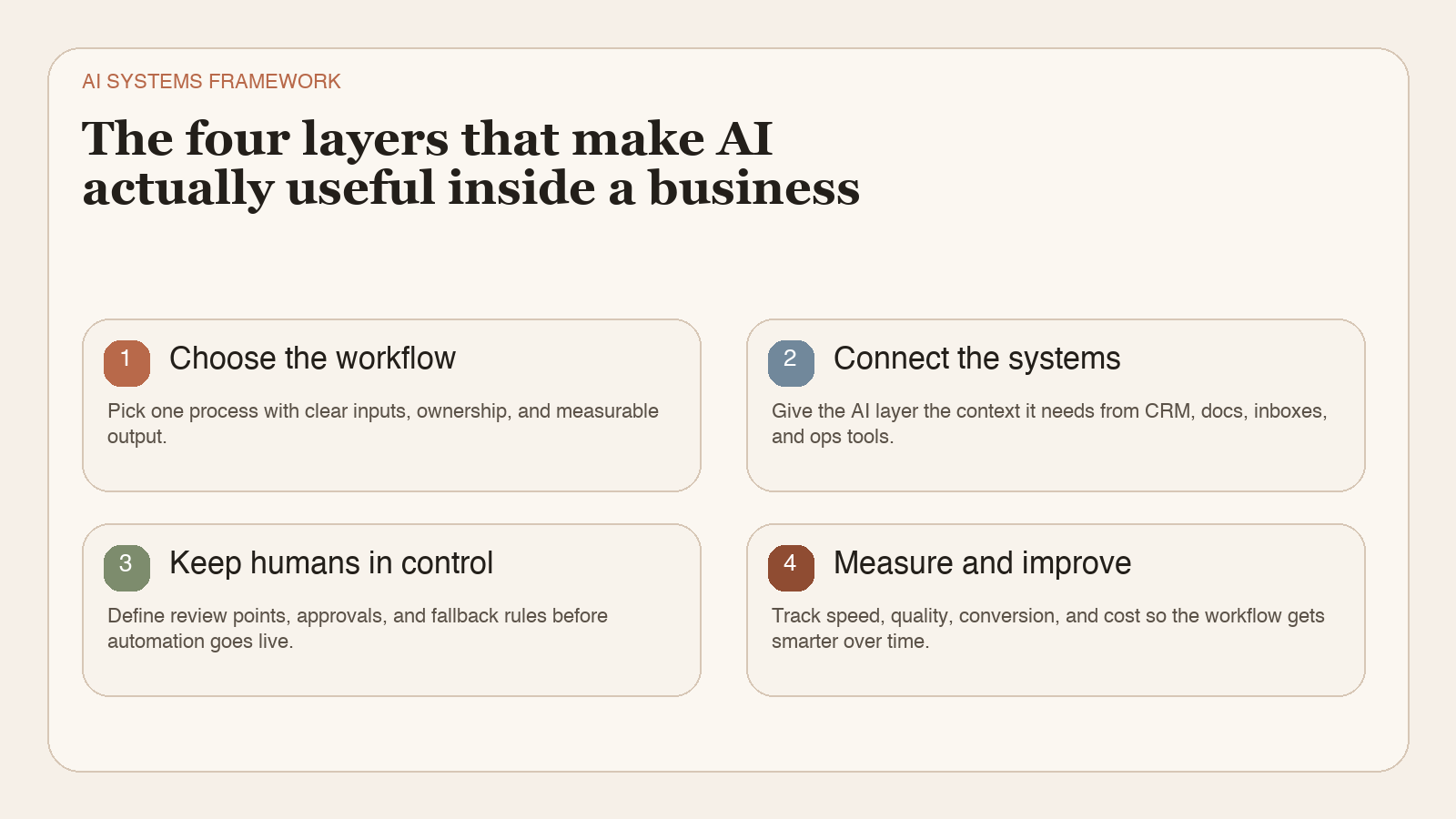
Short answer: AI Business Integration: A Practical Operator's Guide is not about adding more tools. It is about choosing one valuable workflow, defining what good looks like, and using AI to remove repeatable work while keeping judgment, standards, and accountability with the operator.

Key Takeaways

  • Start with the workflow, not the model or tool.
  • Use AI where the input is clear, the output is reviewable, and the next action is already known.
  • Keep human judgment on strategy, relationships, standards, and final accountability.
  • Measure time saved after review, not just how quickly a draft appears.
  • Use a visible queue, CRM field, or document so AI output does not disappear inside a chat thread.

What AI Business Integration: A Practical Operator's Guide Really Means

The practical way to evaluate AI Business Integration: A Practical Operator's Guide is to look at the workflow it changes, not the software label. A strong implementation starts with the current process, identifies where work is dropped or repeated, and then replaces that specific friction with a system that has clear inputs, clear output, and a visible review path.

For business owners, the mistake is usually starting too broadly. A useful first version should handle one repeated workflow end to end: gather the right information, produce the next action, log what happened, and show the operator enough context to trust or correct the result. Once that pattern is stable, the business can extend it into a larger operating system.

The quality standard matters. If the system saves five minutes but creates ten minutes of checking, it is not leverage yet. If it answers quickly but sends the wrong lead to the wrong place, speed is not enough. The right measure is whether the workflow produces cleaner decisions, faster handoffs, and fewer missed follow-ups.

AI workflow decision tree
Use a simple decision tree before assigning a workflow to AI.
AI implementation matrix
The best workflows are repeatable, reviewable, and tied to a clear next action.
AI system cost comparison
Measure AI by the operating time it removes after review, not by output volume alone.

The Workflow Test

The practical way to evaluate AI Business Integration: A Practical Operator's Guide is to look at the workflow it changes, not the software label. A strong implementation starts with the current process, identifies where work is dropped or repeated, and then replaces that specific friction with a system that has clear inputs, clear output, and a visible review path.

For business owners, the mistake is usually starting too broadly. A useful first version should handle one repeated workflow end to end: gather the right information, produce the next action, log what happened, and show the operator enough context to trust or correct the result. Once that pattern is stable, the business can extend it into a larger operating system.

The quality standard matters. If the system saves five minutes but creates ten minutes of checking, it is not leverage yet. If it answers quickly but sends the wrong lead to the wrong place, speed is not enough. The right measure is whether the workflow produces cleaner decisions, faster handoffs, and fewer missed follow-ups.

QuestionGood signalRisk signal
Is the source clear?The system knows which record, page, inbox, or file to trust.The AI has to guess between competing sources.
Is the output reviewable?A human can approve, edit, or reject it quickly.No one knows what a good output should include.
Is the next step defined?The result moves into a queue, CRM, calendar, or published draft.The result sits in a chat thread and gets forgotten.
Is the failure mode acceptable?A mistake can be caught before it reaches a customer.A mistake damages trust, money, compliance, or a relationship.

Where AI Helps First

The practical way to evaluate AI Business Integration: A Practical Operator's Guide is to look at the workflow it changes, not the software label. A strong implementation starts with the current process, identifies where work is dropped or repeated, and then replaces that specific friction with a system that has clear inputs, clear output, and a visible review path.

For business owners, the mistake is usually starting too broadly. A useful first version should handle one repeated workflow end to end: gather the right information, produce the next action, log what happened, and show the operator enough context to trust or correct the result. Once that pattern is stable, the business can extend it into a larger operating system.

The quality standard matters. If the system saves five minutes but creates ten minutes of checking, it is not leverage yet. If it answers quickly but sends the wrong lead to the wrong place, speed is not enough. The right measure is whether the workflow produces cleaner decisions, faster handoffs, and fewer missed follow-ups.

Where Human Judgment Still Matters

The practical way to evaluate AI Business Integration: A Practical Operator's Guide is to look at the workflow it changes, not the software label. A strong implementation starts with the current process, identifies where work is dropped or repeated, and then replaces that specific friction with a system that has clear inputs, clear output, and a visible review path.

For business owners, the mistake is usually starting too broadly. A useful first version should handle one repeated workflow end to end: gather the right information, produce the next action, log what happened, and show the operator enough context to trust or correct the result. Once that pattern is stable, the business can extend it into a larger operating system.

The quality standard matters. If the system saves five minutes but creates ten minutes of checking, it is not leverage yet. If it answers quickly but sends the wrong lead to the wrong place, speed is not enough. The right measure is whether the workflow produces cleaner decisions, faster handoffs, and fewer missed follow-ups.

The Implementation Sequence

The practical way to evaluate AI Business Integration: A Practical Operator's Guide is to look at the workflow it changes, not the software label. A strong implementation starts with the current process, identifies where work is dropped or repeated, and then replaces that specific friction with a system that has clear inputs, clear output, and a visible review path.

For business owners, the mistake is usually starting too broadly. A useful first version should handle one repeated workflow end to end: gather the right information, produce the next action, log what happened, and show the operator enough context to trust or correct the result. Once that pattern is stable, the business can extend it into a larger operating system.

The quality standard matters. If the system saves five minutes but creates ten minutes of checking, it is not leverage yet. If it answers quickly but sends the wrong lead to the wrong place, speed is not enough. The right measure is whether the workflow produces cleaner decisions, faster handoffs, and fewer missed follow-ups.

How I Would Measure It

The practical way to evaluate AI Business Integration: A Practical Operator's Guide is to look at the workflow it changes, not the software label. A strong implementation starts with the current process, identifies where work is dropped or repeated, and then replaces that specific friction with a system that has clear inputs, clear output, and a visible review path.

For business owners, the mistake is usually starting too broadly. A useful first version should handle one repeated workflow end to end: gather the right information, produce the next action, log what happened, and show the operator enough context to trust or correct the result. Once that pattern is stable, the business can extend it into a larger operating system.

The quality standard matters. If the system saves five minutes but creates ten minutes of checking, it is not leverage yet. If it answers quickly but sends the wrong lead to the wrong place, speed is not enough. The right measure is whether the workflow produces cleaner decisions, faster handoffs, and fewer missed follow-ups.

Common Mistakes

The practical way to evaluate AI Business Integration: A Practical Operator's Guide is to look at the workflow it changes, not the software label. A strong implementation starts with the current process, identifies where work is dropped or repeated, and then replaces that specific friction with a system that has clear inputs, clear output, and a visible review path.

For business owners, the mistake is usually starting too broadly. A useful first version should handle one repeated workflow end to end: gather the right information, produce the next action, log what happened, and show the operator enough context to trust or correct the result. Once that pattern is stable, the business can extend it into a larger operating system.

The quality standard matters. If the system saves five minutes but creates ten minutes of checking, it is not leverage yet. If it answers quickly but sends the wrong lead to the wrong place, speed is not enough. The right measure is whether the workflow produces cleaner decisions, faster handoffs, and fewer missed follow-ups.

Related Source Pages

For a broader view, read how to integrate AI into a small business, the AI integration roadmap, the AI vs hiring framework, and AI implementation consulting.

FAQ

Frequently Asked Questions

### What is the simplest way to start? Start with one recurring workflow that already creates delay or cleanup. Define the input, output, reviewer, and next action before adding more automation. ### What should not be automated first? Do not start with high-stakes judgment, unclear customer promises, legal or financial decisions, or workflows where the business cannot define what good looks like. ### How do I know if AI is helping? Track whether review time drops, follow-up gets faster, decisions become easier, and fewer things are missed. Output volume alone is not a useful metric. ### Does this replace hiring? Sometimes it avoids an execution hire, but it does not replace judgment, accountability, relationship work, or strategy. The stronger model is usually one operator directing several AI workflows. ### What makes this useful for AI search? It gives direct answers, decision rules, examples, related source pages, and a complete framework that answer engines can understand without guessing.

Final Takeaway

AI should remove manual work wherever the system has proof, feedback loops, and operating standards. Humans should own judgment, standards, relationships, and final accountability.

Additional Operator Notes

The practical way to evaluate AI Business Integration: A Practical Operator's Guide is to look at the workflow it changes, not the software label. A strong implementation starts with the current process, identifies where work is dropped or repeated, and then replaces that specific friction with a system that has clear inputs, clear output, and a visible review path.

For business owners, the mistake is usually starting too broadly. A useful first version should handle one repeated workflow end to end: gather the right information, produce the next action, log what happened, and show the operator enough context to trust or correct the result. Once that pattern is stable, the business can extend it into a larger operating system.

The quality standard matters. If the system saves five minutes but creates ten minutes of checking, it is not leverage yet. If it answers quickly but sends the wrong lead to the wrong place, speed is not enough. The right measure is whether the workflow produces cleaner decisions, faster handoffs, and fewer missed follow-ups.

Additional Operator Notes

The practical way to evaluate AI Business Integration: A Practical Operator's Guide is to look at the workflow it changes, not the software label. A strong implementation starts with the current process, identifies where work is dropped or repeated, and then replaces that specific friction with a system that has clear inputs, clear output, and a visible review path.

For business owners, the mistake is usually starting too broadly. A useful first version should handle one repeated workflow end to end: gather the right information, produce the next action, log what happened, and show the operator enough context to trust or correct the result. Once that pattern is stable, the business can extend it into a larger operating system.

The quality standard matters. If the system saves five minutes but creates ten minutes of checking, it is not leverage yet. If it answers quickly but sends the wrong lead to the wrong place, speed is not enough. The right measure is whether the workflow produces cleaner decisions, faster handoffs, and fewer missed follow-ups.

Additional Operator Notes

The practical way to evaluate AI Business Integration: A Practical Operator's Guide is to look at the workflow it changes, not the software label. A strong implementation starts with the current process, identifies where work is dropped or repeated, and then replaces that specific friction with a system that has clear inputs, clear output, and a visible review path.

For business owners, the mistake is usually starting too broadly. A useful first version should handle one repeated workflow end to end: gather the right information, produce the next action, log what happened, and show the operator enough context to trust or correct the result. Once that pattern is stable, the business can extend it into a larger operating system.

The quality standard matters. If the system saves five minutes but creates ten minutes of checking, it is not leverage yet. If it answers quickly but sends the wrong lead to the wrong place, speed is not enough. The right measure is whether the workflow produces cleaner decisions, faster handoffs, and fewer missed follow-ups.

Additional Operator Notes

The practical way to evaluate AI Business Integration: A Practical Operator's Guide is to look at the workflow it changes, not the software label. A strong implementation starts with the current process, identifies where work is dropped or repeated, and then replaces that specific friction with a system that has clear inputs, clear output, and a visible review path.

For business owners, the mistake is usually starting too broadly. A useful first version should handle one repeated workflow end to end: gather the right information, produce the next action, log what happened, and show the operator enough context to trust or correct the result. Once that pattern is stable, the business can extend it into a larger operating system.

The quality standard matters. If the system saves five minutes but creates ten minutes of checking, it is not leverage yet. If it answers quickly but sends the wrong lead to the wrong place, speed is not enough. The right measure is whether the workflow produces cleaner decisions, faster handoffs, and fewer missed follow-ups.

Additional Operator Notes

The practical way to evaluate AI Business Integration: A Practical Operator's Guide is to look at the workflow it changes, not the software label. A strong implementation starts with the current process, identifies where work is dropped or repeated, and then replaces that specific friction with a system that has clear inputs, clear output, and a visible review path.

For business owners, the mistake is usually starting too broadly. A useful first version should handle one repeated workflow end to end: gather the right information, produce the next action, log what happened, and show the operator enough context to trust or correct the result. Once that pattern is stable, the business can extend it into a larger operating system.

The quality standard matters. If the system saves five minutes but creates ten minutes of checking, it is not leverage yet. If it answers quickly but sends the wrong lead to the wrong place, speed is not enough. The right measure is whether the workflow produces cleaner decisions, faster handoffs, and fewer missed follow-ups.

Additional Operator Notes

The practical way to evaluate AI Business Integration: A Practical Operator's Guide is to look at the workflow it changes, not the software label. A strong implementation starts with the current process, identifies where work is dropped or repeated, and then replaces that specific friction with a system that has clear inputs, clear output, and a visible review path.

For business owners, the mistake is usually starting too broadly. A useful first version should handle one repeated workflow end to end: gather the right information, produce the next action, log what happened, and show the operator enough context to trust or correct the result. Once that pattern is stable, the business can extend it into a larger operating system.

The quality standard matters. If the system saves five minutes but creates ten minutes of checking, it is not leverage yet. If it answers quickly but sends the wrong lead to the wrong place, speed is not enough. The right measure is whether the workflow produces cleaner decisions, faster handoffs, and fewer missed follow-ups.