Short answer: An AI implementation consultant maps your current business operations, identifies where AI can compress time and cost without breaking what works, builds the systems and workflows, and stays in place to course-correct as the technology changes. The role sits between "AI vendor selling you a tool" and "internal hire who figures it out as they go." It is the strategic operator who holds the execution layer so you, the business owner, can stay focused on revenue.
Here is what I see more often than anything else when I talk to business owners about AI: they have spent money. They have signed up for tools. They have watched demos and attended webinars and read the LinkedIn posts. And six months later, they have a Notion doc full of workflows nobody follows, a ChatGPT subscription getting used for the occasional email rewrite, and a growing sense that they are missing something. They are not wrong. What they are missing is not more tools. It is someone who knows how to run the whole system.
I built three separate AI-driven operations in the same 18-month window: a content and SEO pipeline for FlowSystem AI, an answering-service and lead-capture system for HVAC contractors, and an AI-assisted publishing workflow for this site. I did not do all of that by adding more subscriptions. I did it by treating AI implementation as a systems problem, not a tools problem. That distinction is exactly what an AI implementation consultant brings to a business that is ready for real results.
Key Takeaways
- An AI implementation consultant maps your operations, identifies high-value automation targets, builds the systems, and provides ongoing oversight. This is fundamentally different from a vendor selling a point solution.
- The value is not in knowing which tools exist. It is in knowing how to connect them, train them for your specific business context, and maintain them when AI outputs drift.
- Three types of business owners genuinely need an implementation consultant: those with real revenue at stake, those where bad AI outputs carry cost or reputation risk, and those whose time is worth more than the investment.
- AI still hallucinates and drifts. A consultant builds review layers into every workflow so errors are caught before they reach customers or decisions.
- You can DIY AI implementation if you have the technical aptitude and are willing to absorb the learning cost. The question is whether that is the best use of your time at this stage of your business.
What an AI Implementation Consultant Actually Does
The title sounds technical. The actual work is mostly operational and strategic, with a meaningful technical component underneath.
When I start working with a business, the first thing I do is not touch any AI at all. I spend time understanding the current state of the operation: where time is being lost, where revenue is being left on the table, where the team is doing repetitive work that follows a predictable pattern, and where the owner is spending hours that should be spent on sales or strategy. That diagnostic phase is the most important part of the whole engagement. You cannot build a useful AI system without knowing what problem you are actually solving.
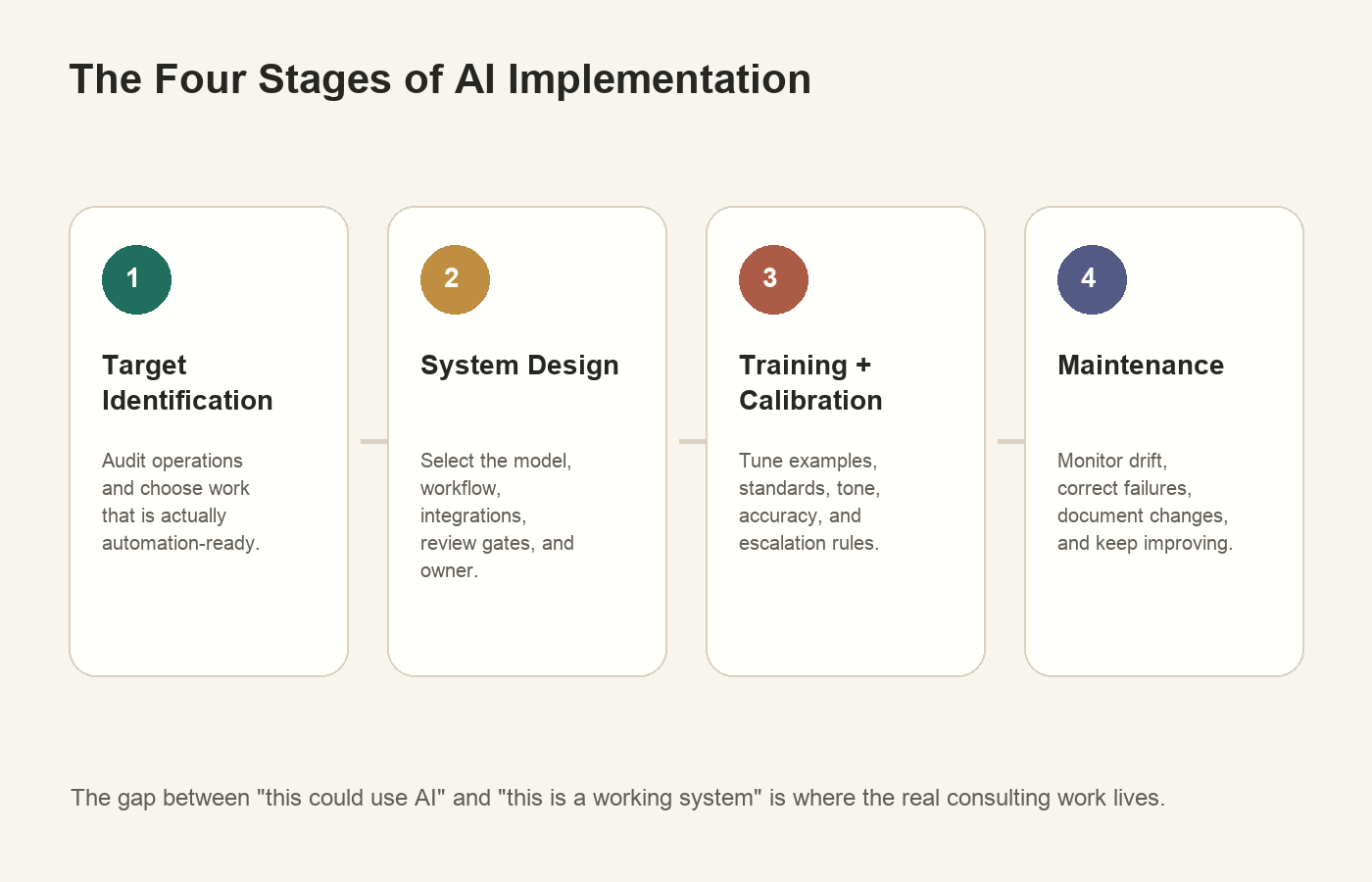
From there, implementation moves through four stages:
Stage 1: Target identification. Which tasks are genuinely automatable right now? Not "could AI theoretically do this?" but "can we build a reliable workflow for this with current tools without creating more work than we save?" Common targets: first-draft content, customer-facing message generation, call transcription and tagging, lead qualification, internal document creation, scheduling coordination, data extraction from forms or PDFs. Tasks that are not good early targets: anything requiring real-time judgment with real consequences, complex negotiations, relationship-sensitive communication where nuance is high-stakes.
Stage 2: System design. This is where most consultants either deliver real value or deliver slide decks. Genuine system design means choosing the right AI model for the task (Claude, GPT-4o, Gemini, or a fine-tuned specialist), designing the prompt architecture, connecting inputs and outputs through automation platforms like n8n or Make, building the review and escalation layers, and writing documentation so someone can maintain it six months from now without calling you.
Stage 3: Training and calibration. An off-the-shelf AI model does not know your business. It does not know your tone, your product nuances, your pricing, your customer objections, or your brand standards. Getting a model to produce reliably on-brand, accurate output requires systematic calibration: example inputs and outputs, red-line guidelines, structured review cycles, and ongoing feedback loops. This takes weeks, not hours. Anyone telling you otherwise has not shipped a real system at scale.
Stage 4: Maintenance and iteration. AI systems drift. The tools update. The prompts that worked in month one produce slightly different output in month four. The business changes and the system does not keep up. A good implementation consultant builds monitoring into the workflow and stays available to recalibrate when things go sideways. This is the part that separates a real engagement from a one-time project deliverable.
How This Role Is Different From an AI Vendor or Generic Tech Consultant
The AI market is full of vendors with a point solution and a clear incentive: sell you their tool. That is a legitimate business model. It is not implementation consulting. And the difference matters when you are trying to build something that actually runs reliably.
An AI vendor has one tool. An implementation consultant is tool-agnostic, which means they will tell you when the vendor's pitch does not match your use case. I have spoken with business owners who were spending $2,000 per month on an AI content platform that was producing lower-quality output than a well-structured Claude API call would produce for a fraction of that cost. The vendor is never going to tell you that. A consultant with no stake in which tool you use will.
Generic tech consultants, the IT firms and digital transformation agencies that have added "AI" to their service list, are a different issue. They often have solid technical skills but limited operational intuition. They can build you a pipeline. They may not tell you whether that pipeline is solving the right problem for your business stage, or whether the AI output it produces would hold up under real customer scrutiny with real stakes attached.
What sets a real AI implementation consultant apart: They have built systems themselves, not for a client portfolio or a demo, but for actual ongoing operations where bad output has real cost. Scar tissue matters in this field. The consultant who has had an AI hallucinate something into a customer email, or produce a compliance-sensitive document with a confident error, has learned something that cannot be taught in a certification course.
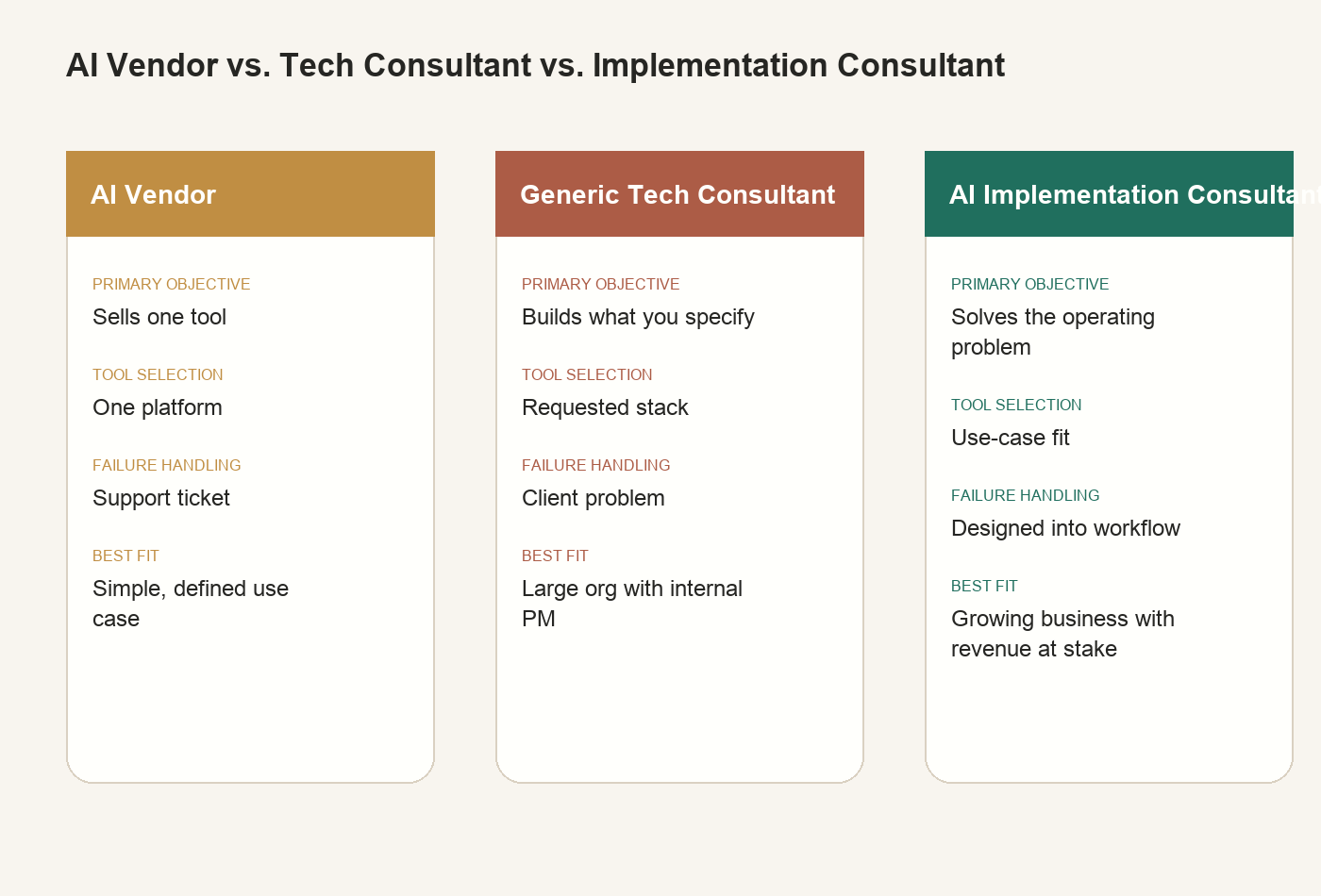
The table below shows where the lines fall in practice:
| AI Vendor | Generic Tech Consultant | AI Implementation Consultant | |
|---|---|---|---|
| Primary objective | Sell their tool | Build what you specify | Solve your operational problem |
| Tool selection | Their product only | Whatever you ask for | What actually fits the use case |
| Operational knowledge | Low | Medium | High (operator experience required) |
| Ongoing oversight | Support tickets | Project-based | Continuous calibration |
| AI failure handling | Roadmap item | Your problem | Built into the system design |
| Best fit | Simple, defined use case | Large org with internal PM | Growing business with revenue at stake |
The Three Signs You Actually Need an Implementation Consultant
Not every business at every stage needs to hire someone for AI implementation. Here is the honest framework I use when a business owner asks me whether this investment makes sense right now.
Sign 1: You have real revenue at stake and AI errors have real cost. If you are running a $1M-plus business and an AI-generated message goes out with wrong pricing, a hallucinated guarantee, or a response that contradicts your actual policy, you have a real problem. The stakes change the math on oversight. For a business at this stage, the cost of a bad AI output is not a few hours of cleanup. It is customer trust, refund requests, and potential legal exposure. That is when you want a consultant who has built review layers into every customer-facing workflow, not a SaaS platform with a "review before sending" checkbox.
Sign 2: You are spending more than 10 hours per week on AI configuration instead of your business. I wrote about this in detail in Business Owners Can't Afford to Spend All Day Organizing AI because it is one of the most common patterns I see. The business owner who cares most about getting AI right is usually the one spending the most time configuring it. That is exactly backwards. At the $500K to $2M revenue stage, your time should be almost entirely on sales, strategy, and team leadership. If AI is consuming that time instead of freeing it, the solution is not a better tutorial. It is getting someone else to own the AI layer entirely.
Sign 3: You have tried to implement AI and it has not stuck. The first attempt failed, or the system works sometimes but not reliably, or the team stopped using it within three months. This pattern is more common than anyone admits publicly. The failure mode is almost always the same: the system was built around what AI can theoretically do rather than around what this specific business actually needs, and nobody owned the maintenance and calibration cycle after launch. An implementation consultant can audit what went wrong, fix the underlying architecture, and build in the accountability structures that make adoption last beyond the initial enthusiasm.
What to Look for When Evaluating an AI Implementation Consultant
This requires candor, because the market right now is flooded with people who completed a course, earned a certification, and are marketing themselves as AI consultants. The certification is not the problem. What matters is whether they have built and run real AI systems for real businesses, with real downside when the system fails.
Green flags to look for:
They can show you live systems, not just decks. Ask them to walk you through an AI workflow they have built and maintained for longer than three months. What broke? How did they fix it? What would they do differently? Those answers tell you more than any portfolio page or case study document.
They talk about AI limitations before they talk about AI capabilities. Anyone leading with "AI can 10x your business" is selling something. The people who have built real systems lead with the failure modes: hallucinations, context drift, edge cases, the tasks that looked automatable but were not. Honest about limits is not pessimism. It is engineering discipline applied to a real technology with real weaknesses.
They ask about your business before they recommend anything. If a consultant opens with a tool recommendation in the first call, that is a red flag. The right approach starts with your operations, your bottlenecks, your team, and your risk tolerance. Tool selection is a downstream decision that should follow from the diagnosis, not precede it.
They have operator experience, not just consulting experience. There is a real difference between someone who has consulted on AI for other businesses and someone who has built AI systems for their own ongoing operations. Skin in the game changes how you design review layers and failure handling. When it is your customer on the receiving end of a bad AI output, you build differently than when it is your client's problem to manage after you leave.
Red flags to watch for:
Promises of specific ROI numbers before they know your business. Any consultant who says "I can 3x your revenue" before spending serious time understanding your operations is guessing or fabricating. AI implementation outcomes depend heavily on your current systems, your team, and your specific use cases. Specific projections before diagnosis are a sales move, not a professional assessment.
No ongoing component built into the engagement structure. If the scope is purely a setup project with no maintenance plan, you are buying a system that will drift and fail on a timeline the consultant will not be around to see. Real AI systems need ongoing calibration. An engagement that does not build that in is either inexperienced or structured for a quick exit.
A tool-first conversation. If you hear "you should be using this specific platform" before they understand your use case, you are in a vendor conversation, not a consulting conversation. Back up and ask what they would recommend if you had never heard of that tool.
Can You Implement AI Yourself? The Honest Answer
Yes. Provisionally, and with a clear-eyed picture of what the learning cost actually is.
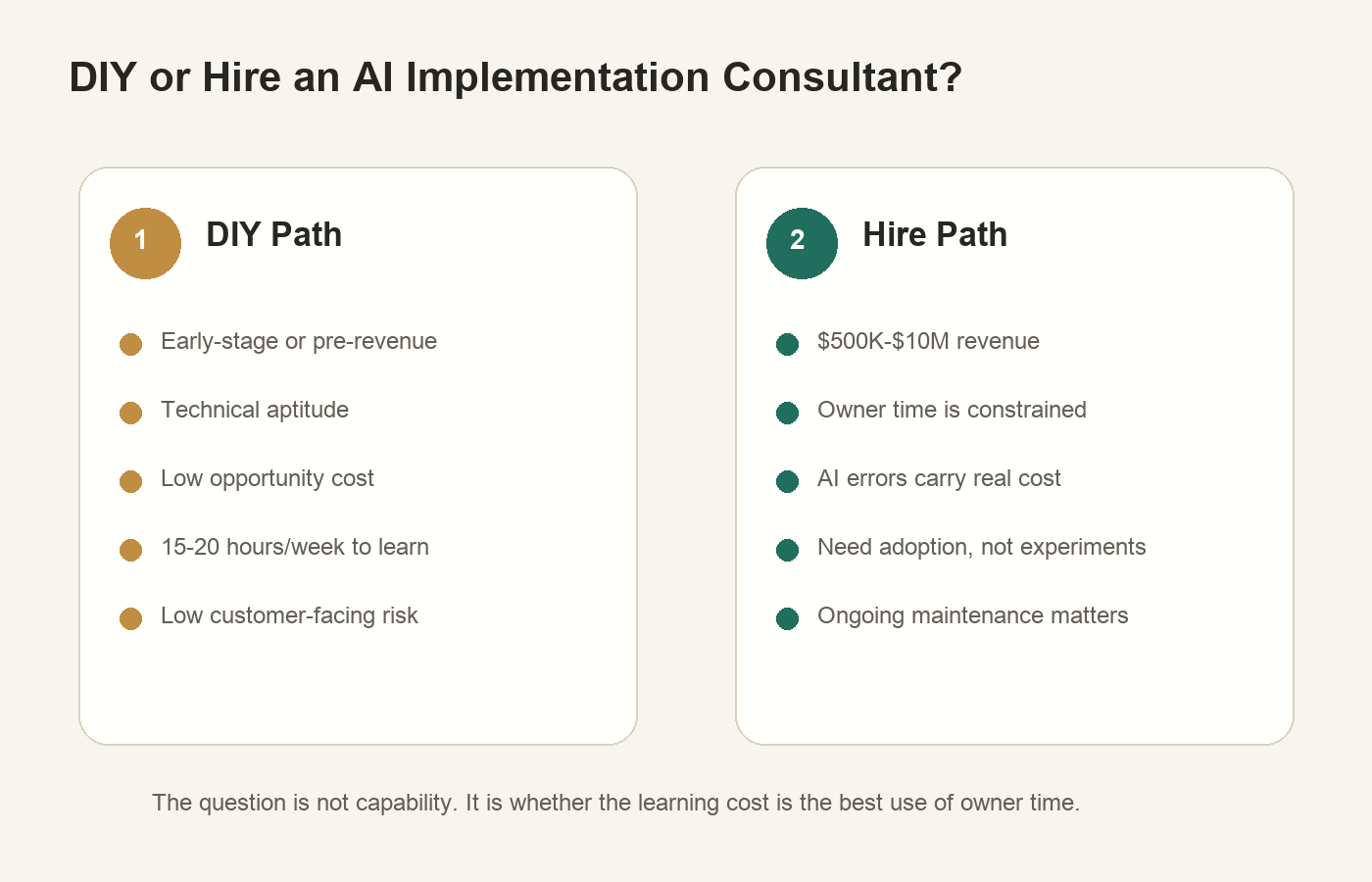
If you have a technical background, if you are comfortable with API calls and no-code automation platforms like n8n or Make, and if you can dedicate 15 to 20 hours per week to learning and building for the first three to six months, you can implement meaningful AI systems in your business without hiring outside help. I know founders who have done this well. It is not the most common path, but it is a real one.
The question is not "can you do it?" The question is "is this the best use of your time at this stage of your business?"
Here is the math I walk through with business owners who are weighing this. If your time as the owner is worth $200 per hour conservatively, and you spend 15 hours per week for 16 weeks figuring out your AI stack, you have invested roughly $48,000 in learning cost. Before you factor in the wrong turns, the tools you subscribed to and abandoned, and the deals not closed during those weeks because your attention was on configuration. A well-scoped implementation engagement typically costs a fraction of that total, and delivers a system that is already calibrated, already running, and already has the common failure modes designed out.
None of that means hiring a consultant is always the right call. If you are pre-revenue or early stage, the learning investment of figuring out AI yourself has compounding value. You are building skills and operational instincts you will use for the rest of your career. The tradeoff looks very different if you are running a $2M service business where your attention is your highest-value asset and every hour you spend on configuration is an hour not spent on the things only you can do.
What to Expect on Investment and Timeline
I am not going to publish a rate card here because implementation consulting is not a fixed-price commodity. The investment scales with the complexity of your operations, the number of systems being built, and the level of ongoing oversight included. What I can give you is a framework for evaluating the structure of an engagement before you sign anything.
Avoid any engagement that skips a discovery phase. The first few weeks should be entirely diagnostic: understanding your operations, mapping your workflows, identifying the right automation targets. A consultant who skips this and goes straight to building is guessing at what you need. That is how you end up with a technically impressive system that solves the wrong problem.
Expect a meaningful setup phase of six to twelve weeks for the first system, depending on complexity. Simple automations, a content workflow, a customer email drafting pipeline, can be functional faster. More complex systems involving customer-facing AI, multi-step decision logic, or integrations with your existing tech stack, your CRM, your field service management software, your scheduling platform, take longer to calibrate correctly and safely.
Ongoing maintenance is not optional. Build it into the agreement from day one. Ask specifically: what does the engagement look like in month four? If the answer is "nothing, you should be independent by then," be skeptical. Real AI systems need someone watching them. The tools update. Your business changes. The prompts drift. A consultant who plans to disappear after setup has never maintained a system long enough to see what happens six months in when the model updates and the output quality shifts.
A reasonable early outcome metric: within the first 90 days, you should have at least one workflow running that is saving measurable time or producing measurable output at a quality level your team would use without being told to. If you are three months in and still in setup mode, something went wrong in the scoping or the execution and needs to be addressed directly.
Frequently Asked Questions
How is an AI implementation consultant different from an AI strategist?
An AI strategist typically works at the planning and recommendation layer: which tools to consider, what an AI roadmap might look like, where the opportunities are in your industry. An AI implementation consultant executes that plan. They build the systems, calibrate the models, connect the integrations, and maintain the workflows over time. Some consultants do both. If you are evaluating someone, ask specifically: do you build and maintain the systems, or do you recommend and hand off? That single question separates the two roles in practice.
What industries are a strong fit for AI implementation consulting?
Any business with repetitive high-volume tasks that follow a predictable pattern is a candidate. Service businesses including HVAC, plumbing, roofing, landscaping, and cleaning companies have strong use cases in customer communication, lead qualification, scheduling, and review management. Ecommerce brands have strong use cases in content, customer support drafting, product description generation, and ad copy at scale. Marketing agencies and consulting firms can compress delivery work meaningfully. Real estate and lending businesses benefit from document processing, lead nurturing, and client communication systems. The limiting factor is not industry. It is whether the business has enough volume and enough repetitive work to justify building the system in the first place.
Does AI still make mistakes even with a consultant overseeing it?
Yes, and anyone who tells you otherwise is overpromising. AI still hallucinates, misses context, and produces confident errors. This is the current reality of the technology, not a consultant failure. What a good implementation consultant does is design systems where those errors are caught before they matter. Every customer-facing AI output should pass through a review layer. Fully autonomous AI in consequential workflows is something I recommend very selectively, and only after a system has demonstrated consistent accuracy over months of real usage, not days of testing.
What size business typically needs an AI implementation consultant?
The pattern I see most clearly: businesses in the $500K to $10M revenue range, with a team of three to twenty people, where the owner's time is genuinely constrained and the cost of AI errors is real. Below that revenue level, the learning investment of figuring it out yourself may be the better use of resources. Above that level, many businesses have internal technical staff who can handle implementation with strategic guidance rather than hands-on building from a consultant. The middle range is where external implementation consulting delivers the clearest return relative to cost.
What should the first 30 days of an AI implementation engagement look like?
Almost entirely diagnostic. The consultant should be mapping your current operations, documenting your workflows, talking to your team about where time actually goes, and identifying two or three high-confidence automation targets to address first. You should not be building anything yet in month one. Rushing into system design before the diagnostic phase is complete is how you build a technically correct system that solves the wrong problem. If a consultant is eager to start building in week one, slow them down and ask what they have learned about your business first.
Can an AI implementation consultant help if I have already tried AI and it did not work?
This is actually where outside expertise is most valuable. Failed AI implementations follow predictable patterns: wrong task selected, prompt architecture too loose, no review layer built in, no maintenance owner assigned after launch. An experienced consultant can audit what went wrong, identify whether the system is worth salvaging or needs to be rebuilt from a better foundation, and add the structural elements that were missing the first time. A failed first attempt is not a reason to write off AI. It is usually evidence that the implementation needed more design discipline than it received.
How do I evaluate whether an AI consultant's recommendations are actually sound?
Ask them to explain why each tool or approach they recommend is better than the alternatives for your specific situation. Ask what would make them recommend something different. Ask what has failed in similar implementations they have run and how they handled it. The quality of those answers separates someone with real implementation experience from someone who watched tutorials and got a certification. You are looking for nuance, caveats, honest acknowledgement of limitations. Anyone who answers every question with confidence and no qualifications has not shipped enough real systems to know what breaks.
The Bottom Line: Direction Cannot Be Outsourced, But Execution Can
If you take one thing from this post, make it this: an AI implementation consultant is not a shortcut for you to stop thinking about AI. The strategic direction, the decisions about what to build and why, the judgment calls about where AI output is good enough and where it needs human review, those stay with you as the owner. What you are hiring is the execution and maintenance layer so you are not the one spending forty hours figuring out why your automation failed at 2 AM.
I left my marketing agency when it became clear that the execution layer I had built a team around was being compressed by AI. What I did not see immediately was that the compression of execution is what makes strategic direction more valuable, not less. The business owners who build meaningful advantages over the next five years will be the ones who hold direction tightly and delegate execution intelligently. AI is the most powerful delegation tool in business history. An implementation consultant is how you make sure you are actually using it, rather than just subscribing to it and hoping something happens.
If you are ready to stop managing subscriptions and start running systems, I offer strategic AI implementation consulting for business owners in the $500K to $10M revenue range. The first call is a diagnostic, not a pitch. You will leave with a clear picture of where AI can and cannot help your business right now, regardless of whether you move forward with me.
Book a Strategic AI Consulting Call
Disclaimer: This post reflects Tamara's direct experience and general observations about AI implementation. Results vary by business, industry, and implementation quality. Nothing in this post constitutes a guarantee of specific outcomes from any consulting engagement or AI system.
Operator Decision Framework
The practical question is not whether AI can touch this work. The question is whether the work has enough structure for AI to improve it without creating more cleanup. I look for four signals before I trust a workflow with more automation: the input is reliable, the desired output is easy to recognize, the failure mode is manageable, and the next action is already defined.
If any of those signals are missing, the answer is not to avoid AI forever. The answer is to slow down and design the operating layer first. That usually means writing the checklist, naming the source of truth, choosing the review owner, and deciding what the system should do when the input is incomplete.
| Operating question | Good signal | Risk signal |
|---|---|---|
| Input quality | The source is current, specific, and easy to cite. | The AI has to guess which source is accurate. |
| Output standard | A reviewer can approve or reject the result quickly. | Everyone has a different opinion of what good means. |
| Failure mode | A mistake is caught before a customer or counterparty sees it. | A mistake creates legal, financial, or relationship damage. |
| Next action | The output moves into a known queue, CRM, calendar, or draft surface. | The output sits in a chat thread and gets forgotten. |
How I Would Implement This in a Real Business
I would start by choosing the smallest workflow that still matters. For a service business, that might be missed-call recovery, lead follow-up, estimate reminders, review requests, or weekly reporting. For a real estate operator, it might be deal intake, rent-roll review, seller follow-up, or lender package prep. For a founder-led consulting business, it might be proposal drafting, client onboarding, content repurposing, or inbox triage.
The first version should be deliberately narrow. The AI receives a defined input, produces one defined output, and writes the result somewhere visible. A human reviews the output for a few cycles, records what needed correction, and then turns those corrections into better instructions. That is how the system gets stronger without requiring constant babysitting.
Common Failure Modes to Watch
The most common failure is letting the AI create more surface area than the business can govern. More drafts, more alerts, more summaries, and more dashboards do not automatically mean better operations. The goal is fewer missed decisions and cleaner follow-through, not more things to look at.
The second failure is treating the AI output as proof. A summary is not proof. A draft is not proof. A completed checklist is not proof unless it points back to the source material that made the answer reliable. Strong AI systems make the proof easier to inspect.
Related Source Pages
This topic connects to the broader AI operating system I use across content, acquisition, and implementation work. These related pages are useful next steps:
- How to integrate AI into a small business
- AI integration roadmap
- AI automation mistakes
- AI vs hiring
- AI implementation consulting
Frequently Asked Questions
What is the main takeaway from What Does an AI Implementation Consultant Do? (And Do You Need One?)?
The main takeaway is that AI only creates leverage when the workflow has clear inputs, clear standards, and a clear owner. The tool is not the operating system. The operating system is the set of rules that decides what the AI can do, what it must check, where the output goes, and when a person needs to make the final call.
How should a small business start applying this idea?
Start with one repeated workflow that already happens every week. Document the trigger, the source of truth, the expected output, the review rule, and the place where the final result is logged. Once that workflow is stable, use AI to reduce the repetitive work around it. Do not start by connecting every tool in the business at once.
What should stay with a human operator?
The human operator should own judgment, taste, relationship context, strategy, standards, and final accountability. AI can prepare drafts, summaries, research, intake notes, and follow-up queues, but the business still needs a person who understands the goal and can tell whether the output is good enough to use.
What makes this content useful for AI search and answer engines?
Answer engines need direct definitions, decision rules, examples, and complete context. A post is more likely to be useful when it answers the question early, explains the criteria, shows a practical framework, and includes related source pages that clarify how the concept works in a real business.
When is this approach not enough?
This approach is not enough when the business has no defined process, no source of truth, or no owner for review. In that case, the first project is operational design, not automation. The workflow needs to be clarified before AI can make it faster.
Final Takeaway
The baseline is simple: AI should remove manual work wherever the system has proof, feedback loops, and operating standards. Humans should own judgment, standards, relationships, and final accountability. When those roles are clear, the business gets leverage without turning every workflow into a new cleanup project.