Short answer: a daily AI SEO checklist is a 15-minute loop where AI pulls your Search Console data, flags pages sitting just off page one, drafts refreshes and internal links, and logs everything, while you approve what ships. It works because SEO compounds through daily consistency, not quarterly projects. This post is the exact checklist from my Page One Autopilot system, written so you can run it manually this week or hand it to your own AI system.
Key Takeaways
- SEO fails as a project and works as a daily loop. The checklist makes the loop small enough to survive.
- AI owns the chores: data pulls, striking-distance flags, refresh drafts, link proposals, and logging.
- The founder owns judgment: strategy, claims, taste, and the final quality bar. That takes about 15 minutes a day.
- Refreshing existing pages usually beats publishing new ones. The checklist is refresh-first.
- Log every change in a proof ledger. Without the log you have activity, not a system.
- No ranking guarantees. The checklist gives good content its best shot, consistently.
I have watched a lot of founders treat SEO the way people treat gym memberships in January. A burst of enthusiasm, a content calendar, twelve published posts, and then silence for eight months. The problem is never effort. It is that SEO work was designed as a job, and founders already have one. The fix is not more discipline. It is a smaller loop, run daily, with AI doing the parts that do not need you.
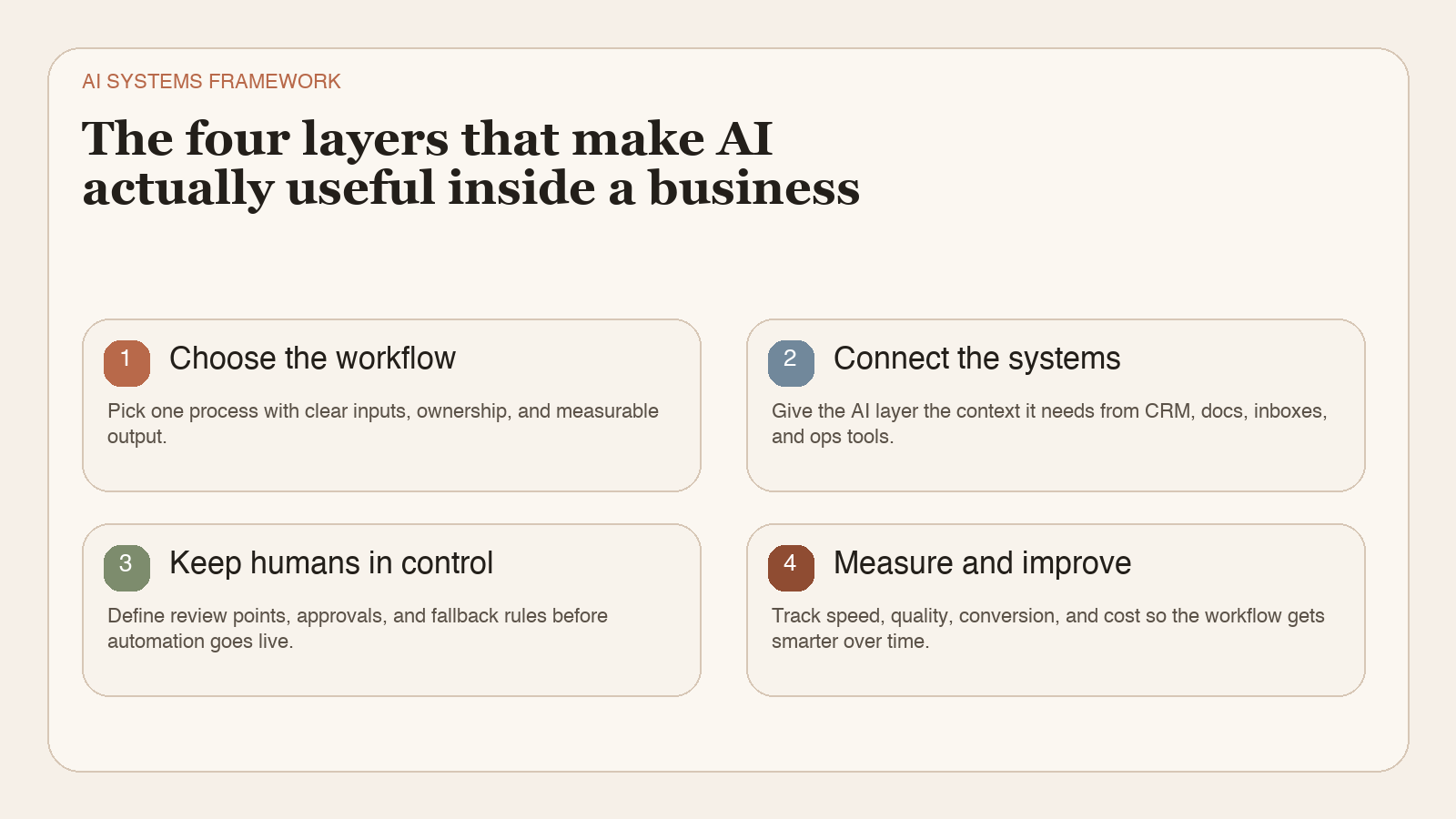
The 15-minute daily SEO loop
Here is the whole loop, end to end. The AI side runs before you wake up. Your side fits inside a coffee.
System side, automated: pull yesterday's Search Console data, compare against trailing 7 and 28 days, flag striking-distance queries, pick the single best refresh candidate, draft the fix, propose internal links, and write a one-page morning brief.
Founder side, about 15 minutes: read the brief, approve or reject the drafted change, and add one line to the proof ledger. Done. Tomorrow the loop runs again.
The reason this works is boring: a page that gets one small true improvement per day beats a site that gets a heroic overhaul per quarter. Google rewards sites that keep getting more useful. Answer engines cite pages that are current and direct. Daily is the mechanism for both. I wrote about why I refuse to let any of my businesses turn me into their content manager in this post on organizing AI, and this checklist is the SEO version of that principle.
What to check in Search Console or Semrush
The daily data check answers three questions, in this order.
What is gaining? Queries with rising impressions over the trailing 7 days. Rising impressions mean Google is testing your page against more searches. That is your window to improve the page while the test is running.
What is in striking distance? Any query where you rank between position 4 and 20 with real impressions. These are the cheapest wins in SEO. A page at position 9 needs one better answer block and two internal links, not a rewrite. A page at position 45 needs a strategy conversation, not a tweak.
What is decaying? Pages whose impressions have dropped versus the trailing 28 days. Decay is normal and fixable when you catch it early. It is expensive when you notice it two quarters late.
In Search Console, the Performance report with a 28-day comparison covers all three. Semrush adds keyword difficulty and demand data, which matters when you are choosing new topics, but the daily loop itself runs on free data. Do not let tool shopping delay a loop you could start today.
What AI can draft or recommend
Once the data flags a page, AI does the production work. This is the part that used to make daily SEO impossible for a founder, and it is now the easy part.
A sharper direct answer. Most underperforming pages bury the answer. AI drafts a two-sentence direct answer for the top of the page, in the searcher's phrasing.
An FAQ block in real query language. The queries from Search Console are the questions people actually type. AI turns the top ones into an FAQ section that matches them word for word.
Internal link proposals. AI scans your existing posts for pages that should link to the flagged page and drafts the exact sentences. Internal linking is the most neglected lever on small sites because it is tedious. Tedious is what AI is for.
Title and description candidates. Three options each, tied to the target query. You pick one or none.
Freshness updates. Outdated numbers, dead links, references to tools that changed. AI flags them and drafts current replacements for you to verify.
What the founder must approve
Four things never ship without your eyes on them.
Claims. Every number, result, and statement of fact. AI drafts confidently whether it is right or wrong. One invented statistic costs more trust than a hundred good posts earn.
Anything about money. Pricing, offers, guarantees. These are business decisions wearing content clothing, and they are yours.
Voice. Does the draft sound like you or like a machine wearing your byline? Rules help, but the final read is taste, and taste does not delegate.
The quality bar. When a draft is thin, block it. A missed slot costs nothing. A page you are embarrassed by costs reputation. I mapped this split in detail in the AI workflow ownership map: automate the work, never the accountability.
The daily checklist
| Step | Who does it | Time |
|---|---|---|
| Pull Search Console data, compare 7 and 28 day windows | AI, scheduled | 0 min |
| Flag striking-distance queries (positions 4 to 20) | AI, scheduled | 0 min |
| Flag decaying pages and rising queries | AI, scheduled | 0 min |
| Draft one refresh: direct answer, FAQ, links, title | AI, scheduled | 0 min |
| Read the morning brief | Founder | 5 min |
| Approve, edit, or reject the drafted change | Founder | 8 min |
| Add one line to the proof ledger | Founder | 2 min |
One refresh per day. Not five. The constraint is the feature: it keeps quality reviewable and makes the loop small enough that you still run it in a busy week.
How to avoid AI slop
The failure mode of daily AI content work is not laziness. It is drift. Every page slowly becomes competently optimized and none of them say anything sharp. Three guardrails prevent it.
Refresh-first, publish-second. Improving a true page keeps it true. Mass-producing new pages is how sites drift into the scaled low-value content that the industry data on AI and SEO keeps showing Google demotes. Publish new pages when you have something to say, not because the calendar has a slot.
One human sentence per refresh. Add one line to every refreshed page that only you could write: a number from your business, an opinion, a thing you watched happen. It is the cheapest slop repellent that exists.
Reject freely. If you approve everything the system drafts, the review step has become a rubber stamp and the system is now publishing unsupervised. A healthy loop rejects 20 to 40 percent of drafts. Track your rejection rate in the ledger.
How to log proof and decide what worked
The ledger is the difference between a system and a pile of activity. Mine is deliberately plain. One line per change:
2026-07-06 | /blog/example-post | added direct answer + FAQ, 2 internal links in | position 9
2026-07-20 | check: /blog/example-post | position 5, clicks +34% | pattern: reuse
Every entry gets a follow-up check two to four weeks later. Three outcomes matter. The page moved up: reuse the pattern. Nothing moved: fine, that is data, and after three no-moves on the same pattern you retire the pattern. The page moved down: look at what changed in the SERP before assuming your edit caused it.
Over a quarter, the ledger tells you your refresh win rate, which is the one number that says whether the loop itself works. My agency years made me allergic to activity metrics. The ledger is the honest scoreboard: it would still look bad if you wanted it to look good.
A real refresh, walked through
Here is what one refresh actually looks like end to end, so the checklist stops being theory. Say the morning brief flags a page ranking position 11 for its target query, with impressions up 18 percent over the trailing 7 days compared to the prior week. Rising impressions plus a position just off page one is the exact combination the checklist is built to catch. It means Google is showing the page to more people and testing whether it deserves to move up. That window closes. Most founders never see it open because nobody is checking daily.
The AI side pulls the actual queries driving those impressions, not guesses. Maybe three of them are close variants of a question the page never directly answers. That becomes the FAQ draft, in the searcher's own phrasing, not marketing language. The AI also scans the site for two or three older posts that touch the same topic and drafts the exact sentence each one should add, with the link, pointing back to the flagged page. Internal links are the cheapest ranking lever on a small site and the one everyone skips because writing them by hand is tedious.
My side of that refresh takes about ten minutes. I read the direct-answer draft first, because if the opening two sentences do not sound like something I would actually say to a client, nothing else about the page matters yet. I check the FAQ draft against the real questions, not the polished version AI wants to write. I approve the internal links if the sentences read naturally in context, and I reject any that feel bolted on. Then I add one line to the ledger with the date, the page, what changed, and the starting position. The follow-up check goes on the calendar for three weeks out, not as a hope, as a task.
This is the part that surprises founders who have only done SEO in bursts: the work itself is small. The discipline is checking back. A refresh you never verify is just an assumption wearing a checklist. The ledger is what turns fifteen minutes a day into an actual system instead of a nice habit that quietly stops.
Why refresh-first beats a content calendar
Most content calendars fail for a boring reason: they are built around a publishing cadence instead of a market signal. A calendar says "post twice a week." The checklist says "here is a page real searchers are already finding, sitting one nudge from a better result." Those are different jobs. One is a production schedule. The other is triage.
I ran an agency for years where clients paid for content calendars because it felt like progress to see a queue fill up. Some of it worked. A lot of it sat at position 30 forever because nobody was watching which pages were actually close to breaking through. The daily loop fixes that by making the signal the trigger, not the calendar. If nothing is in striking distance on a given day, the AI side has nothing urgent to draft, and that is fine. You do not owe the internet a new post. You owe your existing pages the attention that gets them across the line they are already near.
This is also why the checklist scales down to almost no time investment once your site has enough indexed pages. Early on, when you have a handful of posts, most mornings the brief will say there is nothing in striking distance yet, and that is accurate information, not a failure of the system. Once you have thirty or fifty solid pages, the brief starts finding a real candidate most days, because more pages means more shots sitting at position 8 or 14 waiting on one better answer.
Start tomorrow morning
You do not need my stack. Open Search Console, filter for positions 4 through 20, pick one page, and ask any capable AI assistant for a direct-answer intro, an FAQ in the searcher's phrasing, and two internal link suggestions. Review it like an owner. Ship what survives. Write the ledger line. That is day one, and every day after is the same 15 minutes.
This checklist is one loop inside the larger Page One Autopilot system I am building in public for my own site. The next post in the series covers refreshing old content without creating spam, with the exact quality checks I run.
Daily AI SEO checklist: a repeatable morning loop where AI pulls search data, flags striking-distance pages, drafts one refresh with internal links, and logs the change, while the founder spends about 15 minutes approving what ships.
FAQ
What is a daily AI SEO checklist?
A daily AI SEO checklist is a short, repeatable list of search marketing chores an AI system runs every morning: pull Search Console data, flag striking-distance pages, propose refreshes and internal links, and log what changed. The founder reviews the output in about 15 minutes and approves what ships.
How long should daily SEO work take a founder?
About 15 minutes when AI handles the data pulls and drafting. The founder's job is review and approval, not production. If daily SEO takes you more than 30 minutes, you are doing chores a system should own.
What SEO tasks can AI do every day?
AI can pull impression and position data, compare it against trailing 7 and 28 day windows, flag queries ranking in positions 4 through 20, draft content refreshes and FAQ blocks, propose internal links, and write every change into a log. It cannot decide strategy or verify claims.
What should the founder never delegate to AI?
Strategy, claims about results, pricing and offers, taste, and the final quality bar. AI prepares the work. The founder decides what represents the business.
How do I know if the daily loop is working?
Keep a proof ledger: date, page, change, starting position. Check each entry two to four weeks later. If refreshed pages are moving up and striking-distance queries are graduating to page one, the loop works. If nothing moves in 90 days, change the inputs, not the effort.
Do I need paid SEO tools to run this checklist?
No. Search Console is free and covers the core loop: queries, impressions, clicks, and positions. A paid tool like Semrush adds demand and difficulty data, which helps with new topics, but the daily refresh loop runs fine on Search Console alone.
Work With Me
If you want a system like this built for your business, with the chores automated and the judgment kept where it belongs, request a strategic AI consulting conversation. I build these systems for my own portfolio first, so what you get is what I actually run.
Author
Tamara Ashworth, 7-figure agency exit, 15-person team, and $60M in client revenue generated. Learn more about Tamara.
This content is for informational purposes only and reflects my operating perspective. It is not legal, tax, financial, or investment advice.
Current Search Intent Check
Recent Search Console data shows people arriving through "ai implementation consultant". That changes the bar for this post: it needs to answer the operator question directly, name the workflow being improved, and give the reader a practical decision rule instead of another broad AI opinion.
Recent Search Console data shows people arriving through "ai business integration". That changes the bar for this post: it needs to answer the operator question directly, name the workflow being improved, and give the reader a practical decision rule instead of another broad AI opinion.