
Short answer: Automated real estate investing systems are not systems that buy property for you. They are systems that turn repetitive research, deal notes, document cleanup, follow-up, and reporting into a reliable operating layer so you can make better owner decisions faster. I use AI for the assembly work, then keep the calls that move capital, relationships, and risk squarely human.
That distinction matters. I am a buyer-operator, not someone looking for a magic button that “finds deals while I sleep.” The useful version of automation makes the pipeline easier to see and harder to neglect. It gives me a cleaner call queue, a consistent underwriting-prep process, a list of missing diligence questions, and a weekly view of what deserves my attention. It does not replace a site visit, a seller conversation, a financing decision, or my judgment about whether a deal belongs in the portfolio.
Key Takeaways
- Automated real estate investing systems should support an investor’s judgment, not simulate it.
- The best first automations organize lead research, follow-up, document intake, and weekly review.
- Every workflow needs a source of truth, a named owner, and an explicit human review gate.
- AI is strong at preparing context and surfacing missing work. It is weak at credibility, negotiation, and capital allocation.
- Start with one bottleneck you can measure, then earn the right to automate the next one.
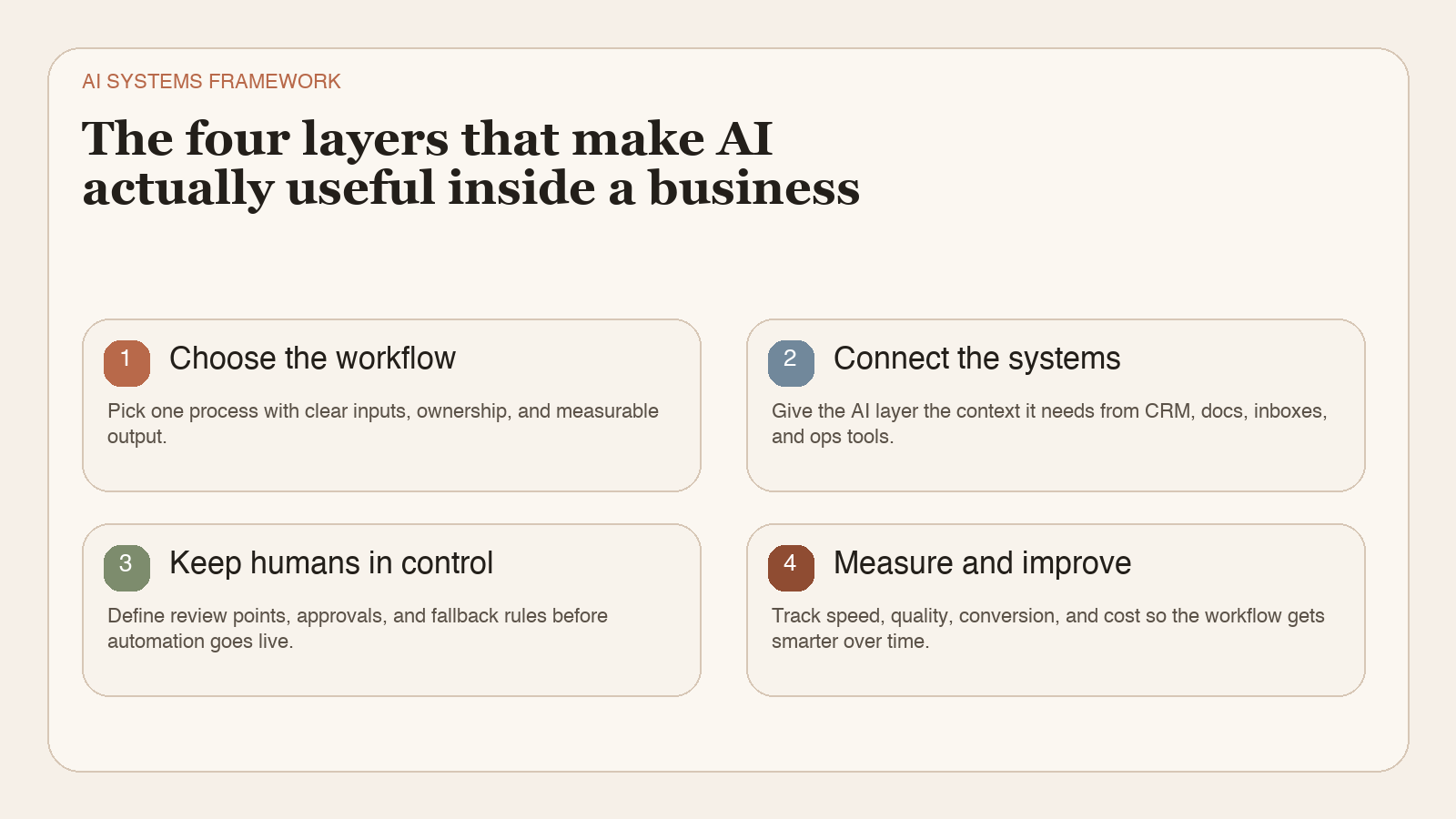
Table of Contents
- What an automated real estate investing system actually is
- The five layers I would build first
- The human boundary
- A practical multifamily workflow
- How to build without creating more work
- A 30-day implementation plan
- Frequently asked questions
What an Automated Real Estate Investing System Actually Is
An automated real estate investing system is a set of repeatable handoffs, not a stack of disconnected tools. It begins with a real operating question: where is the investor losing time, context, or follow-through? For some people, it is leads spread across a broker inbox, a spreadsheet, and notes on their phone. For others, it is a pile of T-12s and rent rolls that never make it into a comparable format. For a growing portfolio, it may be vendor updates and recurring property tasks that arrive but never reach a useful weekly decision.
The system takes that messy input and gives it one route. A lead becomes a record with its source, property facts, buy-box fit, next action, and owner. A seller conversation becomes a summary, a follow-up date, and the facts still unverified. A new deal package becomes a checklist with the documents received, the calculations prepared, and the questions that need human answers. That is operations, not artificial intelligence theater.
Operator definition: An automated real estate investing system is a documented workflow that makes the next right human action visible, repeatable, and traceable. AI can prepare the work. The investor still owns the decision.
That is also why I do not begin with “Which AI tool should I use?” I begin with the workflow. If the team cannot describe where a lead comes in, who reviews it, what makes it worth a call, and where the next action lives, adding automation just creates faster confusion. The tool is the last decision. The operating design comes first.
On my site, that design is consistent across deal flow, underwriting support, seller follow-up, and portfolio operations. The goal is operational leverage: fewer hours lost to assembly and more time for the rooms, relationships, and capital decisions that actually belong to an owner. You can see the specific boundaries in my AI for real estate investors workflow.
The Five Layers I Would Build First
I would build an automated real estate investing system in layers because each layer solves a distinct failure point. Trying to automate everything at once is how an investor ends up paying for software nobody trusts. A small, working layer is more valuable than a sophisticated system the owner avoids.
1. Source capture and buy-box screening
Every lead should land in one source of truth, whether it arrives through a broker, public record, referral, stale listing, or direct owner outreach. The record needs the basic asset facts, source, date received, a note about buy-box fit, and one next action. AI can research publicly available context, summarize the initial materials, and flag missing fields. It should not declare a property a fit simply because it matches a few filter values.
2. Research and owner-call preparation
This is where automated research earns its keep. A workflow can collect property context, ownership history where publicly available, market notes, prior contact history, and questions produced from your buy box. The output should be a short human-readable brief, not a hundred tabs. I want to know what matters before I make the call, what I still do not know, and what would disqualify the opportunity.
3. Underwriting preparation
AI can extract line items from a messy document package, map them to a standard template, list assumptions, and run a first pass of the arithmetic. That does not mean it underwrites the deal. The investor must check the source documents, set vacancy, management, reserves, financing terms, and the decision criteria. My article on AI underwriting support is built around that exact line.
4. Relationship-aware follow-up
Good deal flow is rarely a one-message event. A system can remind you who needs a call, bring forward the prior conversation, draft a starting point, and tell you when a promised document has not arrived. It should not pretend to be you. Seller trust, broker relationships, and negotiation timing are human work. The automation’s job is to make the context easy to retrieve so the relationship is handled better, not more mechanically.
5. Weekly owner review
The final layer turns activity into a decision meeting. Once a week, I want a short report: new opportunities, items stalled too long, missing documents, offers or decisions due, and follow-up that needs my voice. The report is only useful if it ends in an owner action. A dashboard that does not change what happens next is decoration.
The Human Boundary Is the System
Most automation mistakes come from drawing this boundary too late. People see that AI can summarize a rent roll or write an email, then quietly let it make an implied recommendation. That is the moment the system becomes dangerous. A confident summary can carry a wrong number, a stale public record, or a seller’s framing straight into an owner’s decision.
| Workstream | Good automation use | Human-owned work |
|---|---|---|
| Lead intake | Create record, tag source, flag missing fields | Decide whether the opportunity merits attention |
| Research | Gather public context and summarize materials | Judge relevance, credibility, and local nuance |
| Underwriting prep | Normalize documents, calculate stated scenarios | Set assumptions, verify inputs, decide price and terms |
| Seller follow-up | Surface history, draft a starting point, schedule reminders | Build trust, negotiate, and send the message |
| Diligence | Track requests and summarize documents | Inspect, verify, consult legal and tax professionals |
| Portfolio operations | Route updates and summarize recurring reporting | Hold people accountable and allocate capital |
The table is intentionally simple. AI is good at repeatable preparation where the answer can be traced to a source. Humans own questions that require accountability, experience, trust, local judgment, or a willingness to live with the downside. I call this out directly in what AI should not do in real estate investing, because speed without ownership is not leverage. It is just a faster way to make an unexamined mistake.
There is another benefit to naming the boundary: it makes a system easier to adopt. A broker, analyst, assistant, or partner is much more likely to use a workflow when they understand where it helps them and where it does not try to replace them. Good operations reduce ambiguity. They do not hide it behind a prompt.
A Practical Multifamily Workflow
Here is the practical version I would use for multifamily. A new lead enters from a broker email, referral, direct owner message, or a listing that has been sitting long enough to be worth a closer look. The system creates the deal record and captures what arrived with it. A research assistant prepares a one-page brief: location, unit count, asking price if known, stated operations, prior conversations, public context, and the questions missing from the first package.
Then comes the first human gate. I compare the opportunity to the buy box and decide whether it gets a call, a document request, or a respectful pass. Nothing is automated beyond that decision. If it moves forward, the workflow requests the standard documents, logs their arrival, and organizes the materials for underwriting preparation. The model receives the T-12, rent roll, utility and tax information, and any seller narrative as inputs, while the underwriting template stays buyer-owned.
The system can highlight a missing management expense, a rent roll that does not reconcile to the income statement, or a line item that needs a source check. It can run scenarios after I state the assumptions. It cannot decide that a seller’s explanation is credible or that a neighborhood’s changing demand is captured by last year’s financials. Those are the questions I take into a conversation, a drive-by, a site visit, and a deeper diligence process.
After the call, the workflow preserves the context. It records the stated motivation, the promised follow-up, the missing facts, and the date the relationship needs attention again. That is how a deal-flow system becomes compounding rather than episodic. The same core design is behind my multifamily deal-flow system: more consistent preparation, more disciplined follow-up, and a visible owner gate on the steps that matter.
How to Build Without Creating More Work
The fastest way to create an expensive mess is to automate an unclear process. Before adding a tool, map the work as it exists now. What starts the workflow? What information must be present? Where does the record live? Who owns the next action? What ends the workflow? If nobody can answer those questions, the next move is not integration. It is operational cleanup.
I use a simple three-part filter. First, is the task repetitive enough to have a standard handoff? Second, can the output be checked against a source or a clear rule? Third, does the automation create a useful human action? If the answer to one of those is no, I keep the task manual until the underlying process is clearer. The same standard applies to public-facing AI work: Google’s guidance on using generative AI content responsibly is useful because it focuses on whether the output is helpful and accurate, not whether a tool happened to touch the first draft.
| Start here | Wait on this | Why |
|---|---|---|
| Deal intake form and source-of-truth record | Autonomous offer recommendations | Records are repeatable. Offer judgment is not. |
| Document checklist and missing-item reminders | Unverified financial extraction as fact | The checklist creates clarity. Numbers still need review. |
| Weekly stalled-deal report | Fully automated seller conversations | Reports prompt action. Relationships need a person. |
| Call-note summaries and task routing | One giant all-in-one dashboard | Small workflows earn trust before a broader system does. |
Ownership is the other requirement. A workflow that sends five reminders but has no named owner does not solve the problem. It just produces more notifications. Give each stage an accountable person and define what “done” means. That is how you know whether automation reduced manual overhead or merely moved it into a different inbox.
The site’s operator stack is built on this philosophy. Research, drafting, routing, and reporting are useful only when they leave the human sharper and more available for judgment. The stack does not exist to make the business look automated. It exists to help the business run cleaner.
A 30-Day Implementation Plan for an Investor
For a small investor or an owner-led acquisition team, I would not begin with a six-month build. I would make one real workflow reliable in thirty days, then decide what deserves the next layer. The first month is about proving that the system creates better decisions, not accumulating software.
Days 1 to 7: pick the bottleneck and document reality
Choose one bottleneck with visible cost. Maybe deals go cold because follow-up lives in memory. Maybe document packages pile up because nobody knows what is missing. Maybe a weekly review takes two hours of manual status gathering. Write the workflow as it happens today, including the messy parts. Then define the evidence that will show improvement: fewer stale leads, faster first-pass review, or a shorter weekly reporting cycle.
Days 8 to 14: create the source of truth and review gate
Create one durable record for every active item. Make the required fields unambiguous, assign ownership, and name the human decision gate. If this is deal flow, it might be “new,” “research ready,” “call,” “document request,” “underwriting,” “pass,” or “active follow-up.” The labels are less important than consistent meaning. Build the manual version first and use it for a week.
Days 15 to 21: automate the preparation work
Now automate only the repeatable steps: intake capture, research brief assembly, missing-document reminders, call-note summaries, task creation, or the weekly report. Require sources where possible. Keep the automation from sending money-moving communications or changing a decision state without human confirmation. Review every output closely in this phase, because the exceptions teach you how to tighten the workflow.
Days 22 to 30: measure, repair, and decide the next layer
At the end of the month, ask whether the owner made faster or better decisions. Look at the workflow itself, not vanity metrics. Are leads easier to prioritize? Are missing documents identified earlier? Did follow-up happen when promised? Did the weekly review generate clear next actions? If yes, keep the layer and document it. If no, repair the process before moving on.
This is also where outside implementation can help. If you own an operating business and want the intake, follow-up, reporting, or admin layer mapped in the right order, my work is built around that operator-first approach. The right system is the one your team can maintain after the build, not the most impressive demo.
Frequently Asked Questions
What are automated real estate investing systems?
They are repeatable workflows for sourcing, research, underwriting preparation, follow-up, diligence, and operations. They reduce the manual assembly work around a deal so the investor can spend more time on verification, relationships, and capital decisions.
Can AI buy real estate without an investor?
No. AI can prepare research, summarize records, flag gaps, draft follow-up, and calculate stated scenarios. It cannot accept accountability for price, financing, negotiation, legal review, tax treatment, a site visit, or the final investment decision.
What should I automate first in a real estate business?
Start with the repetitive work that already has a clear handoff: lead capture, structured deal notes, document checklists, research summaries, reminder-based follow-up, and a weekly pipeline review. Pick one bottleneck where success is easy to see and keep the first build narrow.
Do automated real estate systems work for small investors?
Yes. Small investors often benefit because they cannot afford to let good leads disappear into an unstructured inbox. A source-of-truth list, a standardized deal checklist, and a weekly owner review can create meaningful leverage before any complex tooling is needed.
How do I keep seller follow-up from feeling automated?
Let the system prepare the context and surface the next action, but keep the relationship human. Review the message, reference what the person actually said, and do not use automation as a substitute for a thoughtful call or reply.
What is the biggest risk of automated real estate investing?
The largest risk is treating clean output as verified truth. Make every important fact traceable to a source, make every assumption visible, and retain a human review gate before any decision that affects capital, relationships, or legal obligations.
Build the Operating Layer Before You Add More Tools
The real promise of automated real estate investing systems is not passive ownership. It is better ownership. When the research, documents, follow-up, and reporting are organized into a dependable preparation layer, the owner has more room to make the calls that no system should make for them.
If your team is buried in intake, follow-up, reporting, or manual admin, book an intro call. I build the systems I use inside my own businesses first, then help owner-led teams install the operating layer that gives their best people time back.
About Tamara Ashworth: Tamara Ashworth is a buyer-operator, investor, and builder who uses AI systems to source, evaluate, acquire, and operate businesses and real estate assets while keeping owner judgment human. Learn more about Tamara.
Educational only. This article is not investment, legal, tax, or financial advice. Verify information with qualified professionals before making a real estate investment decision.