Short answer: AI can help real estate investors gather information, summarize documents, prepare call notes, score sourcing signals, and keep follow-up organized. It should not replace seller trust, site visits, legal advice, tax advice, financing structure decisions, or final underwriting ownership.
The line I care about is simple: AI can support the decision. It should not own the decision.
This is where I see the market get sloppy. Once a model gets good at producing clean summaries and confident language, people start treating it like the investor in the room. It is not. It is a fast research assistant with no real stake in the consequences.
I think the cleanest way to frame the issue is this: AI can lower the cost of preparation without lowering the cost of being wrong. That means the operator has to become more disciplined about where the machine stops, not less disciplined.
Key Takeaways
- AI is strong at gathering, summarizing, comparing, and reminding.
- AI is weak at trust, nuance, accountability, and consequence-heavy judgment.
- Real estate decisions need explicit review gates so the model never quietly becomes the decision-maker.
- The more money and complexity involved, the more important those review gates become.
- Responsible AI use in real estate means letting the model prepare the work while the human keeps ownership.
Decision Support Is Not Decision Ownership
A model can be right about many facts and still be the wrong party to make a decision.
That distinction matters more in real estate than in many other fields because every deal lives inside messy context: seller psychology, financing realities, local market nuance, legal structure, capex surprises, and the operator's actual ability to execute the business plan after closing.
AI can reduce the time it takes to review the file. It cannot absorb the consequences if the file was read incorrectly or if the story behind the file was misunderstood.
I think about it this way: the investor owns risk. The model does not. That alone is enough reason to keep the final call human.
That accountability point matters because real estate is not a trivia exercise. A wrong recommendation can cost money, damage trust with a seller or lender, and distort the pace of the entire acquisition process. The model never carries that consequence. The operator always does.
That is also why I do not find "the model was right 80 percent of the time" to be a reassuring standard for consequential workflows. In a real transaction environment, the 20 percent matters. The question is not whether AI is useful on average. The question is whether the workflow catches errors before they change action.
What AI Does Well in Real Estate
There is a lot it can do well, and the list is meaningful.
- Summarize broker packages and long email threads
- Highlight missing diligence items
- Organize seller call notes and follow-up tasks
- Compare multiple deals against a fixed buy box
- Prepare question lists before a lender or seller call
- Track off-market sourcing signals across repeated public sources
All of those are helpful because they reduce friction at the preparation layer. When I use AI in real estate, that is exactly where I want the leverage. I want the prep work to be faster and cleaner so my time goes toward conversations, analysis, and decisions.
This is why I remain strongly pro-AI in real estate while still drawing hard boundaries around it. The preparation layer is real work. Compressing it creates meaningful leverage. The mistake is confusing leverage with permission to stop thinking.
For example, before a seller call I want AI summarizing prior touchpoints, ownership records, broker context, and missing diligence items. Before a lender discussion I want it comparing scenario assumptions and surfacing inconsistencies. Before I revisit a stalled lead, I want it reminding me what actually happened last time instead of leaving me to rebuild the context from scratch.
Those are all real forms of value. They reduce friction. They shorten decision cycles. They improve follow-up quality. None of them require pretending that the model should own the consequence of the next move.
That is the same philosophy behind my broader AI for real estate investors work. The system should help the operator arrive better prepared. It should not blur who is responsible for the final action.
What AI Should Not Own
Here is the line I would not let it cross.
Seller trust and conversation tone
A model can draft prep notes. It cannot build trust with a seller in a nuanced conversation where context shifts minute to minute.
Site-visit judgment
Walking a property, reading deferred maintenance, sensing neighborhood context, and spotting operational reality are still human tasks.
Final underwriting
AI can organize assumptions. It should not own the final decision about whether those assumptions are realistic enough to risk capital on.
Legal and tax interpretation
These areas carry too much consequence and too much context sensitivity to hand to a model summary. Real professionals need to own them.
Financing structure
Debt terms, recourse tradeoffs, reserve implications, and timing pressures require real judgment. AI can help compare options, but it should not choose the structure.
| AI-supported | Human-owned |
|---|---|
| Summarizing a broker package | Deciding whether the package is credible enough to proceed |
| Preparing diligence questions | Choosing which answers change the investment case |
| Scoring sourcing signals | Deciding whether an owner conversation is worth pursuing now |
| Drafting follow-up notes | Reading tone, trust, and negotiation posture in the actual exchange |
| Comparing scenario outputs | Owning the final buy, pass, or restructure decision |
The Review Gates Every Real Estate AI Workflow Needs
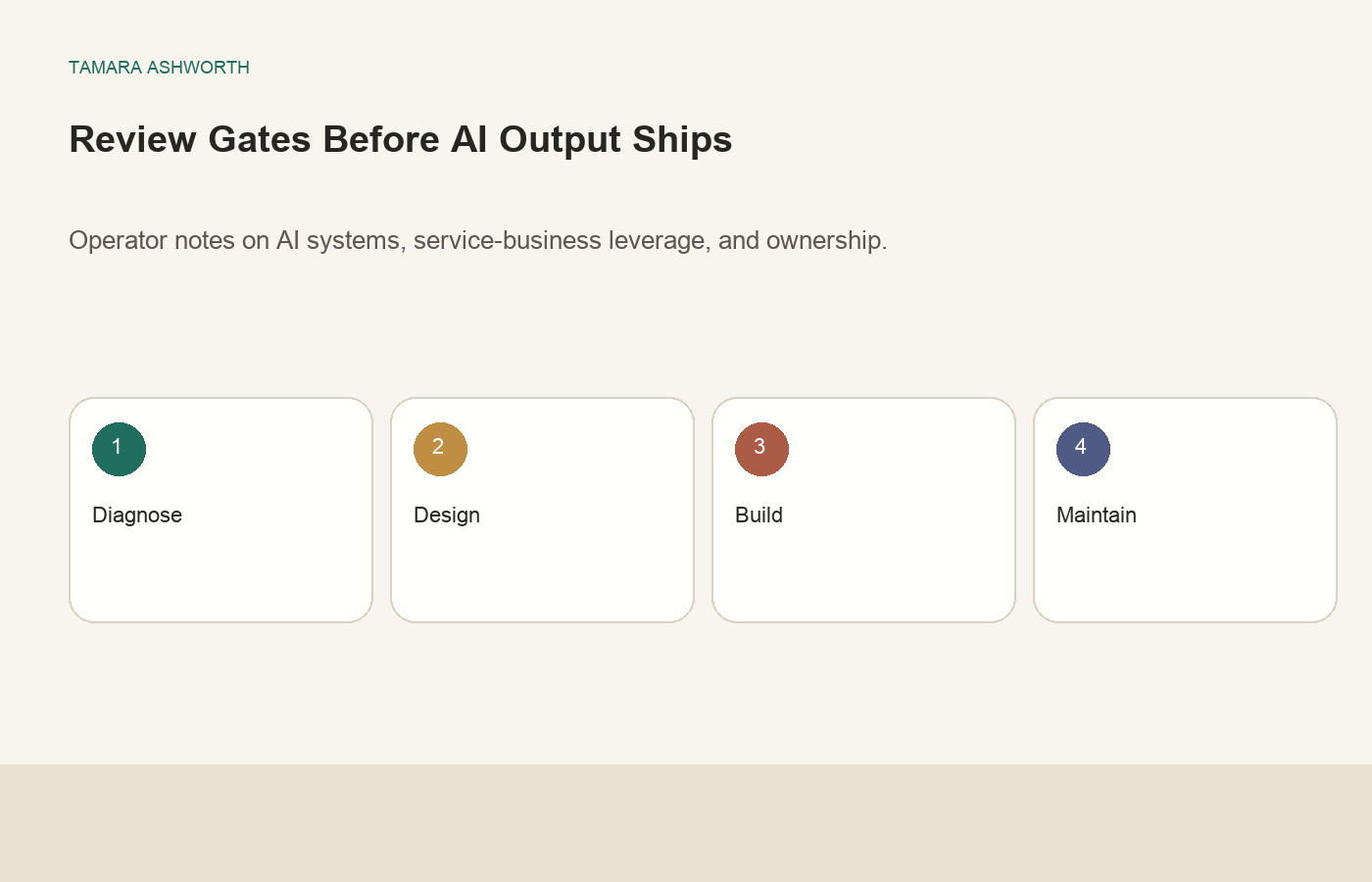
Every useful AI workflow in real estate should answer three questions clearly.
First: what is the model allowed to do alone?
Second: where must a human review before anything moves forward?
Third: who owns the final consequence if the recommendation is wrong?
If the answers are fuzzy, the workflow is too risky.
For example, in a sourcing workflow I am comfortable letting the model normalize records, summarize notes, and produce a ranked queue. I am not comfortable letting it label a seller as motivated and trigger fully autonomous outreach without a human looking at the context.
In an underwriting workflow, I am comfortable letting the model compare scenarios and flag inconsistent assumptions. I am not comfortable letting it decide the rent-growth case or tell me a debt structure is safe just because it looks mathematically neat on paper.
A healthy review-gate structure also makes post-mortems easier. If something goes wrong, you can identify whether the issue came from weak data, unclear instructions, missing review, or simply asking the model to do too much. Without that structure, every failure gets lazily blamed on "AI" and nothing actually improves.
That is one reason I like keeping the workflow visible in Notion or another cockpit layer. If a decision-support system is helping with real estate, I want to see where it begins, what it outputs, who reviewed it, and what happened next. Clean operational visibility makes responsible AI use much more practical.
AI should make the investor better prepared, not less accountable.
An Example of the Right Workflow Shape
Here is what a healthy workflow looks like in practice.
AI reads the broker package, prior notes, and ownership record. It summarizes the property, flags missing documents, compares the asset against the buy box, and drafts a list of follow-up questions. Then a human reviews that output, decides whether the summary is reliable, and uses it to prepare the actual call.
After the call, AI can summarize the conversation and update the queue. A human still decides whether the seller's tone, the financing reality, and the actual numbers justify moving forward.
This is the pattern I trust because it gives me leverage without pretending the machine has judgment.
Where Operators Usually Get Themselves in Trouble
The most common failure mode is outsourcing conviction.
A model sounds confident. The summary is neat. The spreadsheet looks organized. That can create a false sense that the investment case is stronger than it is. The cleaner the output, the more disciplined the operator has to be about checking what is still uncertain.
The second failure mode is using AI to accelerate weak process. If the buy box is vague, the notes are inconsistent, and the review gates are missing, the model just helps you move bad decisions faster.
The third failure mode is forgetting that real estate is relationship-heavy. Seller trust, lender credibility, broker reputation, and local operator context all matter. A model can help you prepare for that world. It does not replace participation in it.
There is also a confidence trap. The cleaner the memo, the more likely people are to over-trust it. That is why I like pairing AI summaries with explicit labels for what is confirmed, what is inferred, and what still needs a human to verify in person.
Another trap is letting the machine flatten time horizon. A model may treat all facts as equally current when a human operator would immediately know which detail is stale, which assumption is market-specific, and which risk only matters after closing. Real estate is full of context that is technically visible but operationally misweighted.
If you want the positive version of this boundary, it is straightforward: use AI to make yourself more prepared, more organized, and more consistent. Do not use it to convince yourself that consequence-heavy judgment has become a software setting.
That is also why I think this boundary is a competitive advantage, not a limitation. The investors who use AI well will not be the ones who outsource their thinking. They will be the ones who keep their judgment sharp while removing as much repetitive friction as possible from the path to that judgment.
Frequently Asked Questions
Can AI underwrite real estate deals?
It can assist with underwriting tasks such as organizing inputs, checking consistency, and comparing scenarios. It should not own the final underwriting conclusion or the investment decision.
What real estate decisions should always stay human?
Seller trust, legal and tax interpretation, financing structure, site-visit judgment, and the final buy or pass decision should remain human-owned.
How should investors use AI safely?
Use it for preparation, summaries, diligence organization, and follow-up support. Build explicit review gates before any consequential decision or outreach step becomes final.
Is AI still worth using in real estate if it cannot own the decision?
Yes. The value is in saving time and improving preparation. That is already meaningful leverage if the investor keeps ownership where it belongs.
If you want help building AI systems that support the operator instead of replacing the operator, that is the work I do through strategic AI consulting. The right system sharpens your judgment. It does not pretend to be your judgment.