Short answer: Using AI to build SOPs after buying a business starts with structured interviews with the seller and key staff during the agreed transition window, feeding those transcripts to AI to produce first-draft standard operating procedures, then running each draft through a review and test loop before it counts as a real SOP. AI turns spoken, half-remembered process knowledge into a written, formatted document fast. It cannot verify the steps are accurate, decide which steps represent the standard you actually want going forward, or catch the step an employee left out because they assumed everyone already knew it. That verification and standard-setting stays with you, every time.
Key Takeaways
- Undocumented knowledge can be a serious risk during an ownership transition. If a process only exists in a seller's or a lead employee's head, you do not own a business yet, you own a dependency on that person staying forever.
- AI can turn recorded interviews and screen-share walkthroughs into first-draft SOPs quickly, but a draft is not a standard until a human tests it against reality and signs off.
- Not every process deserves a full SOP in week one. A simple decision table, based on frequency and risk, tells you what to document first, what can wait, and what should stay judgment-based.
- The review and approval loop, draft, test, revise, approve, is the part that actually determines whether an SOP gets followed or ignored six months later.
- The three failure modes that kill SOP projects are drift (nobody updates them), hallucination (AI invents a plausible-sounding step nobody actually does), and over-documentation (SOPs for judgment calls that should stay judgment calls).
- You measure whether an SOP worked by whether a new hire can execute the task correctly without asking the person who used to do it. Anything short of that is still a draft.
In this guide: why the transition window matters; how to capture a walkthrough; the review loop; a priority table; an illustrative estimating example; what to measure; and frequently asked questions.
Why the First SOPs You Write Determine Whether You Own a Business or a Dependency
When evaluating a small business, inspect how much of the work is documented and how much depends on the seller or longest-serving employees. In a seller-dependent company, estimating may rely on memory. An office manager may know the supplier fallback but have no written rule. These are examples to investigate during diligence and transition, not assumptions about every company.
When the seller becomes unavailable after the agreed transition period, that knowledge either left the building with them or it got captured. There is no third option. A predictable failure mode is postponing documentation until daily work takes over. The new owner can then become dependent on ad hoc calls to the seller for questions that could have been captured during the transition. Building SOPs is how you convert a person-dependent business into a system-dependent one, which is the entire point of buying a business instead of hiring yourself a very expensive job.
Where SOP-Building Sits in the First 90 Days
I would place this work alongside the broader sequence in the AI-first 90 days after buying a small business: stabilize operations and cash first, then capture knowledge before it walks, then build the systems that run the business without you in the room. SOP capture should start during the agreed transition window while the seller is available. The exact weeks depend on the transaction and operational priorities. Waiting until that window closes makes verification harder.
This also feeds the operating rhythm in my first 90 days AI operating plan. SOPs are the raw material that lets you delegate and eventually run the kind of AI-assisted operating team across three businesses I describe elsewhere. None of that works if the underlying processes only exist as tribal knowledge.
Step 1: Interview the Seller and Staff, Let AI Turn the Transcript Into a Draft
The capture method is simple and does not require special software beyond a recording tool and whatever AI model you already use. The owner can sit down with the seller, or the employee who owns a process, and ask them to walk through the task exactly as they actually do it, not as they think it should be done. With consent, record the conversation or screen for a software-based task. Interruptions kill this kind of interview. Let the walkthrough run long and messy first, then clean it up in the next step.
Three practices make the interview usable afterward. Ask for the exceptions, not just the happy path. "Walk me through what you do when the part is backordered" surfaces more real process than "walk me through the ordering process," because exceptions are where undocumented judgment calls live. Ask why, not just what, since a step without a reason attached gets followed mechanically until someone changes it without understanding what it protected against. And get the frequency: a step done fifty times a day needs a tight SOP, a step done twice a year needs more judgment room, since over-specifying a rare task usually produces a document nobody opens.
Once the interview is recorded, AI does the transcription and the first draft in one pass: turning the raw, conversational walkthrough into a numbered SOP with a clear title, a purpose statement, the tools needed, the steps in order, and a callout for any exceptions mentioned. This is where AI earns its keep. A draft that would otherwise require manual transcription and formatting can be assembled faster, freeing your time for the part that actually requires you: checking whether the draft is true.
Step 2: The Review and Approval Loop
A first draft SOP is not a real SOP. It is a hypothesis about how the task gets done, generated from one person's account of their own work, which is inherently incomplete because people are bad at noticing the steps they do automatically. The review loop turns the hypothesis into something you can put in front of a new hire and trust.
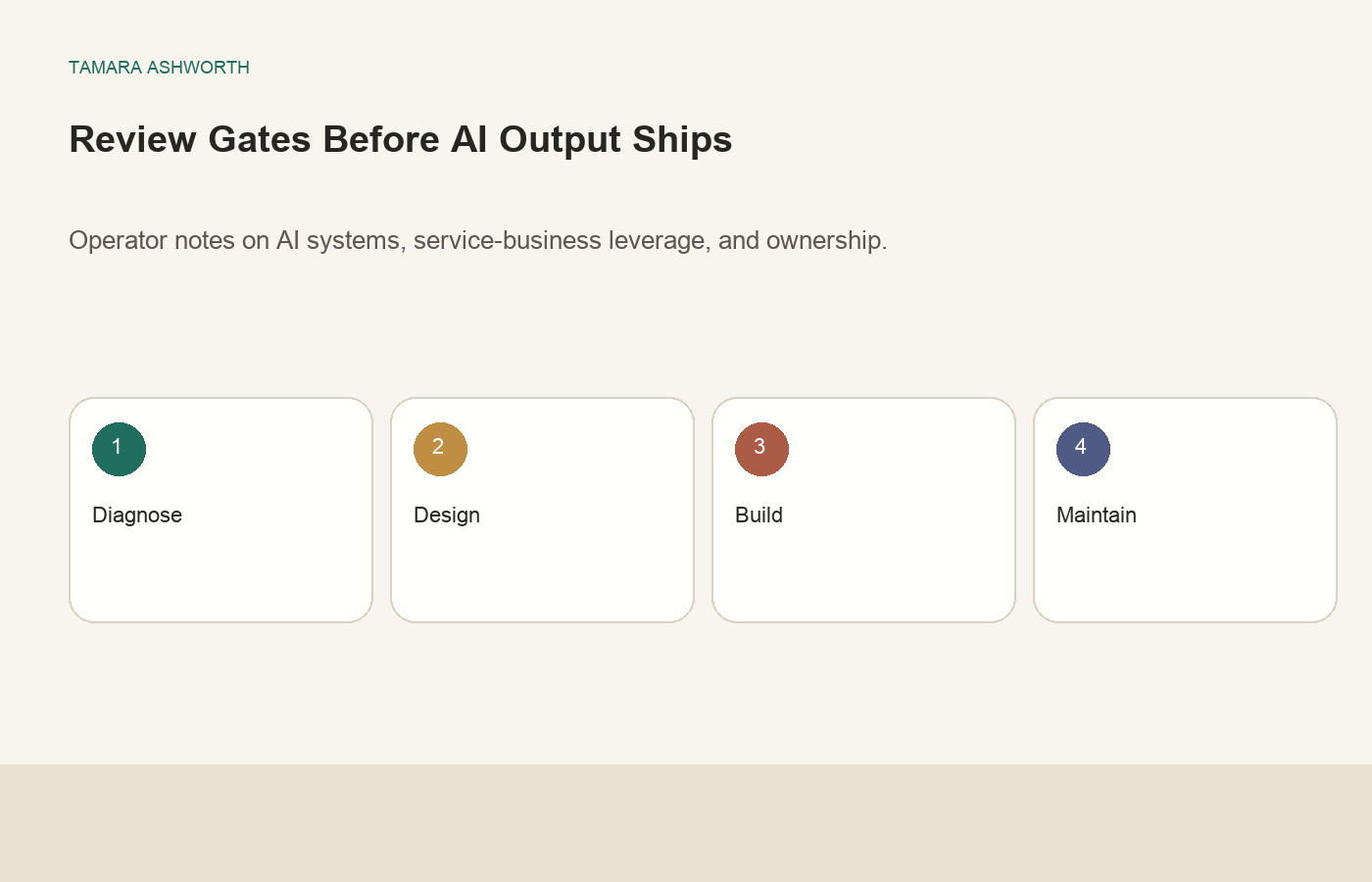
The loop has four stages. Draft: AI produces the first version from the interview transcript. Test: someone who did not do the original interview follows the written SOP exactly as written and notes every place it was unclear, wrong, or missing a step. Revise: gaps get fixed, either by going back to the original interviewee with a specific question or by adjusting the document directly. Approve: once the SOP has been followed successfully by someone other than its source, it gets a version number, a date, and an owner, and moves into the working operating manual.
Skipping the test stage is the single most common shortcut that quietly wrecks SOP projects. A document that reads clearly is not the same as one that works when someone tries to follow it. A plausible test failure is a missing login step or an unstated folder destination. The tester should record these gaps rather than improvising past them. The test is cheap. Skipping it and finding out three weeks later, from a customer complaint, is not.
Where AI Drafts vs Where the Owner Sets the Standard
I would make the division of responsibility explicit before drafting:
| SOP-building task | AI handles | Human owns |
|---|---|---|
| Interview transcription | Converts recorded audio or screen-share into a clean, searchable transcript | Deciding who to interview first and what questions actually surface the real process |
| First draft SOP | Structures the transcript into numbered steps, a purpose line, and a tools list | Judging whether the draft reflects the actual current process or an idealized version of it |
| Consistency across documents | Applies the same formatting, numbering, and terminology across every SOP in the manual | Deciding what the terminology and format standard should be in the first place |
| Gap flagging | Flags steps that reference an undefined term, tool, or decision point | Resolving the gap by going back to the source or making the call directly |
| Version control | Tracks changes and dates across revisions so nothing gets silently altered | Approving a new version as the current standard for the team to follow |
| What the standard should be | Can show you how competitors or industry playbooks typically structure a process | Deciding what standard this business runs going forward, which is an ownership decision, not a drafting one |
What "the standard" actually means: A draft SOP describes what one person did one time. A standard is the version of that process you have decided everyone on the team follows going forward, including the exceptions and the reasons behind each step. AI can describe the first. Only you can declare the second, because declaring a standard is an ownership decision about how the business runs, not a documentation task.
What Should You Document First? A Decision Table
You cannot document everything in week one, and trying to is its own failure mode. For safety-sensitive work, the review standard should reflect the applicable requirements and expert guidance. See OSHA's training guidance on demonstrating competency and matching instruction to workers. This article does not prescribe a universal safety procedure. I would sort each candidate process against two questions: how often does it happen, and what breaks if it is done wrong.
| Process type | Priority | Why |
|---|---|---|
| Safety, compliance, or licensing-sensitive steps | Document and validate before delegation | Getting these wrong can create legal or physical risk. Ask the qualified person responsible for safety or licensing to review the procedure before staff use it. |
| Anything only the departing seller can do | Document in week one to two, while they are still reachable | This knowledge has a closing window. Once the seller is unavailable, the cost of capturing it correctly goes up sharply. |
| High-frequency customer-facing steps (intake, first call, complaint handling) | Document in weeks two to four | These touch revenue and reputation every single day. A gap here shows up immediately as a lost customer or a bad review. |
| High-frequency back-office tasks (invoicing, scheduling, payroll) | Document in weeks two to six | These free the most owner time once written down, because they are repetitive and rule-based rather than judgment-heavy. |
| Low-frequency, high-variability tasks (unusual customer disputes, rare equipment failures) | Document a decision framework, not a rigid script, and revisit after 90 days | These happen too rarely and vary too much for a step-by-step SOP to hold up. Over-specifying them creates false confidence instead of real preparedness. |
| Culture, tone, and values-level judgment | Never fully systematize | How you want the business to treat people is a leadership decision you model and coach, not a checklist AI can draft on your behalf. |
Illustrative Example: Turning an Estimating Walkthrough Into a Tested SOP
Consider a hypothetical service company where the seller handles estimates and the process is undocumented. Estimating would be a priority for knowledge transfer because another person will need a reliable way to prepare and review quotes. This example illustrates the method; it is not a client result or an acquisition I am claiming to have completed.
A useful interview could walk through several representative jobs from start to finish: how the seller sizes up the work on-site, which supplier price sheet they check first and why, how they build in a margin cushion for jobs with an unusual layout, and what they say to a customer who pushes back on price. AI turns that transcript into a draft SOP with a decision tree for the margin adjustment, a site-visit checklist, and a script outline for the price conversation. Imagine a first test run by an existing lead technician finding two gaps: the draft never mentions checking whether the job requires a permit, and it does not explain what to do when the supplier's listed price is more than 48 hours old. Those gaps should be resolved with the seller and tested again. Compare the resulting estimate with source pricing and the approved margin policy; document and investigate any difference. No fixed percentage tolerance works for every job. The approval bar is that a qualified person can follow the procedure safely and produce an estimate the accountable owner accepts.
Measuring Whether an SOP Actually Worked
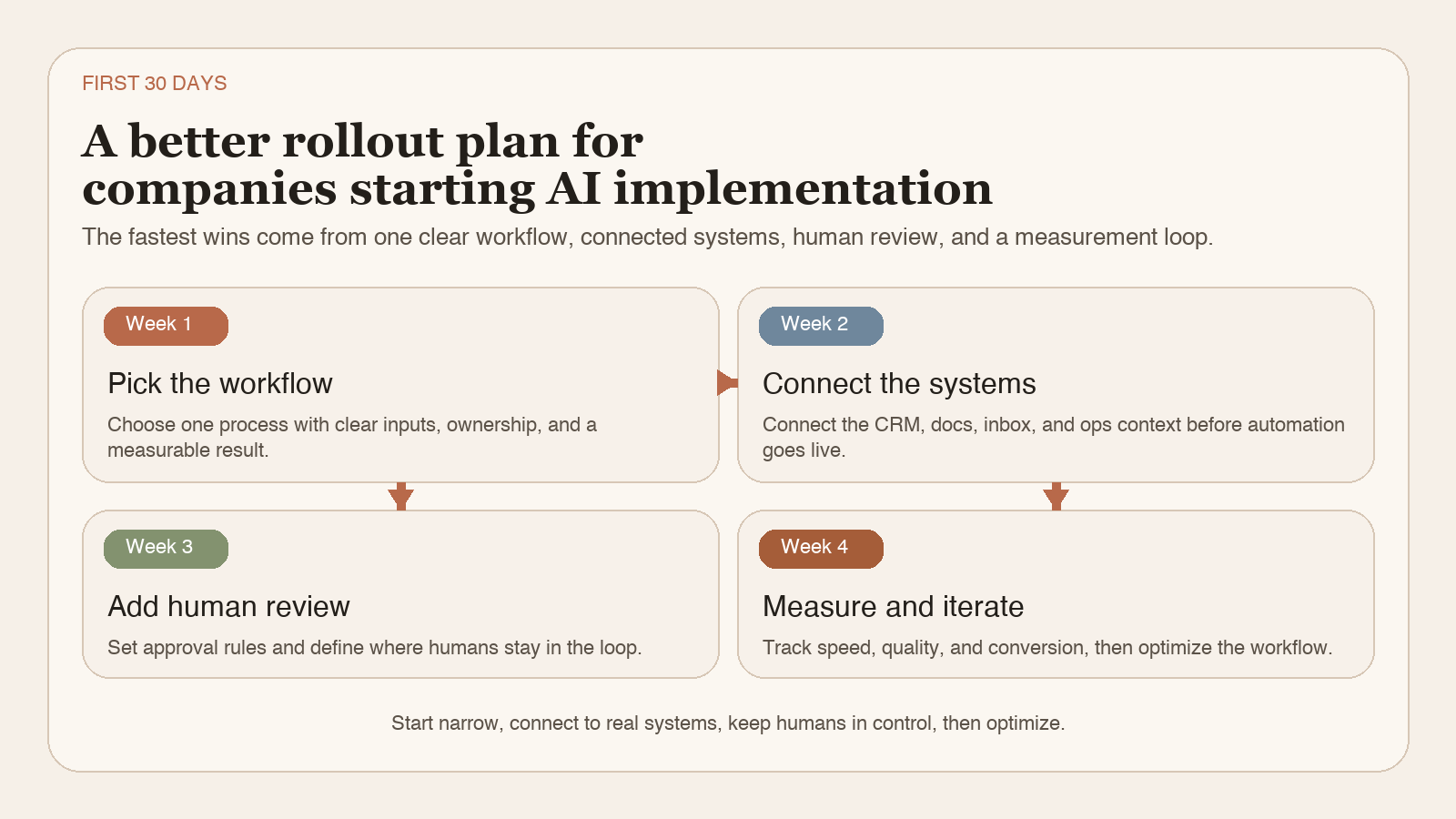
The test that matters is not whether the document looks professional. It is whether someone who was not the original source of the knowledge can execute the task correctly using only the written SOP. Can a new hire complete the task correctly on the first or second attempt using only the document? Does the output match what the original expert would have produced, in actual result, not just in form? And does the SOP still hold up sixty to ninety days later, after the business has hit an exception the document did not originally anticipate?
That third check is the one most owners skip, and the one that actually proves durability. A document that worked perfectly in week three and has never been challenged since is not proof of a good SOP, it might just mean nobody has hit the edge case yet. I would schedule a deliberate revisit of each high-priority SOP around the 90-day mark to ask what broke and what needs to change.
Failure Modes: Drift, Hallucinated Steps, and Over-Documenting
SOP drift. The document gets approved and filed, then the actual process quietly changes over the following months while the written version never gets updated. Six months later the SOP describes a process nobody follows, and new hires get trained on a fiction. The fix is a standing quarterly review, owned by whoever runs that department rather than left to whoever remembers.
Hallucinated steps. AI is generating a plausible-sounding SOP from a transcript, and plausible is not the same as accurate. A model can smooth over a gap in the interview by inserting a step that sounds like something a business like this would do, even when nobody here actually does it that way. This is exactly why the test stage is not optional. Every step in a draft SOP needs to be verified against what someone actually does, not accepted because it reads convincingly.
Over-documenting. Not every decision belongs in a rigid script. A new owner could write a rigid script for handling an angry customer, even though complaints differ. It does not, and a rigid script makes the team sound robotic instead of adaptive. For judgment-heavy, low-frequency situations, write a decision framework instead of a numbered procedure, and trust trained people to apply judgment inside clear guardrails.
Why the Process Matters More Than the Model
None of this depends on which AI tool you use. The advantage AI gives you here is speed and consistency in drafting, not better judgment about what the standard should be. Businesses that end up with SOPs nobody follows are not the ones that used the wrong model. They are the ones that skipped the interview discipline, skipped the test stage, or made every process a rigid checklist regardless of how much judgment it actually required. That discipline, capture first, draft fast, test hard, approve only after verification, is the same discipline I apply across running an AI-assisted operating team across multiple businesses, and it only works because humans keep owning the parts that require judgment, exactly the line I draw in the what-only-a-human-can-do framework. AI does not replace the owner's judgment about what the standard should be. It removes the excuse for never getting around to writing the standard down.
What This Costs You If You Skip It
Owners who skip disciplined SOP-building do not usually notice the cost right away. The business runs fine because the seller is still around, informally, answering questions. The real cost shows up later: a key employee leaves and takes a process nobody else can perform correctly, or a new hire takes three times longer to ramp because they are learning by trial and error instead of from a document. None of that shows up on a balance sheet in month one. It shows up as inconsistent service quality and an owner who still cannot take a real week off eighteen months after close, which defeats a large part of the reason to buy an existing business with real staff and process already in place.
FAQ
How soon after closing should I start building SOPs?
Start in the first one to two weeks, while the seller is still available and employees are still doing the job the way they always have. Waiting until things "calm down" almost always means waiting until the seller is gone and the cheapest source of accurate process knowledge has left the building.
Do I need special software to do this, or can I use AI tools I already have?
You do not need specialized SOP software to start. A recording tool for the interview and any general-purpose AI model can turn a transcript into a formatted first draft. Dedicated knowledge-base platforms become useful later for organizing a growing manual, but they are not required to capture the knowledge in the first place.
What if the seller does not want to participate in interviews after closing?
Address this in the transition agreement before you close, not after. Ask counsel to address seller availability and knowledge-transfer scope in the transition agreement, and prioritize the highest-risk, most owner-dependent processes first in case the availability window turns out shorter than promised.
Can AI write an SOP directly from a video walkthrough instead of a written transcript?
Yes. A screen recording or a video of someone performing a physical task can be transcribed and described in enough detail for AI to draft an SOP from it, the same way it would from an audio interview. Video often captures details a verbal walkthrough misses, like exactly how a tool is held or which order two nearly simultaneous steps happen in.
How many SOPs does a small business actually need?
Fewer than most new owners assume. Focus on processes that are high-frequency, high-risk, or uniquely dependent on one person, using the decision table above, rather than documenting every task in the business. A small set of tested SOPs people actually use can be more useful than a large binder nobody opens.
What is the single biggest mistake new owners make with AI-assisted SOPs?
Treating the first AI-generated draft as finished. The draft is a hypothesis based on one person's account of their own work, and it needs to be tested by someone else before it becomes a real standard. Skipping that test is how hallucinated or incomplete steps end up baked into a document the whole team relies on.
If you just closed on a business and you are staring down weeks of tribal knowledge walking out the door with the seller, I can help map the handoff, choose what deserves a written procedure, and set a test and review loop. Explore AI Implementation With Tamara and bring the org chart.
About the author: Tamara Ashworth is an operator, investor, and founder who built and exited a marketing company. She writes about ownership, operating systems, and AI-supported work.
Editorial note: The estimating example is illustrative. This article describes a proposed transition workflow, not a completed acquisition, measured client result, legal requirement, or substitute for qualified safety and compliance review.
Current Search Intent Check
Recent Search Console data shows people arriving through "integrate ai for small businesses". That changes the bar for this post: it needs to answer the operator question directly, name the workflow being improved, and give the reader a practical decision rule instead of another broad AI opinion.
Recent Search Console data shows people arriving through "automated real estate investing systems". That changes the bar for this post: it needs to answer the operator question directly, name the workflow being improved, and give the reader a practical decision rule instead of another broad AI opinion.